
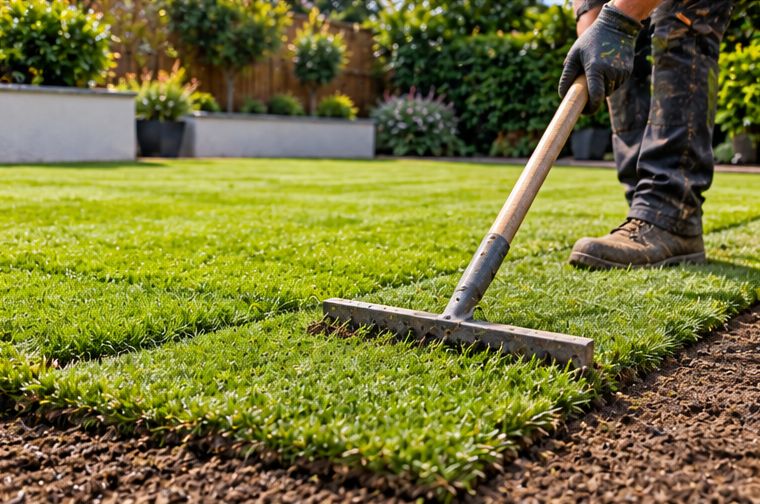
On a country property around Talgarth, a new lawn is rarely a neat square behind a semi. It might be the grass around a converted barn, a former paddock being brought into the garden, or the whole plot around a farmhouse after building work has churned it up. At that scale, small mistakes in preparation are multiplied across a very big area.
This guide explains how we approach a large lawn near the Black Mountains, from reading the ground to the first few cuts. It sits alongside our turf laying and lawns service and the landscaping in Talgarth page.
How much of it really needs to be lawn?
Before anything else, it is worth deciding how much fine lawn you actually want to mow. A large Talgarth garden often works best with a generous, well-made lawn near the house and rougher grass or meadow further out, with mown paths through it. That keeps the good lawn to a manageable size and puts the effort where you will see it most.
The same question shapes the choice between turf and seed. Turf gives an instant, usable lawn and copes better with heavy rain on a slope, while seed can make sense for the outer areas where you are happy to wait. Our guide to turf or seed sets out the trade-offs, and many big plots end up with a mix of both.
Reading the ground first
The soil around Talgarth varies a great deal over short distances. Some gardens have decent loam; others have stone just below the surface, heavy clay in the low corners or thin soil over rock on the higher side. Old paddocks can be badly compacted by years of hooves and vehicles.
- Rushes and moss in an old field usually point to poor drainage or compaction.
- Thistles, docks and nettles suggest rich but neglected ground that will need clearing and weed control.
- Bare, stony patches tell us topsoil is thin and more will be needed.
- Ruts and soft spots after building work show where the ground has been damaged and needs breaking up.
We dig a few test holes on the first visit to see what is underneath. It is the most useful half hour of the whole job.
Clearing, draining and levelling
Large areas usually need clearing first: scrub, old fencing, rubble and weeds. On an overgrown plot, see clearing overgrown land around a Talgarth property for how that stage works.
Wet areas are dealt with next, while the ground is open. On a slope below the hills, a drain across the top of the lawn can intercept water running down from above before it soaks the grass. Low hollows may need a land drain running to a soakaway or ditch.
Then the ground is cultivated, stones and roots removed, and the surface levelled and firmed. On a big lawn we aim for smooth, flowing levels rather than perfectly flat, so the lawn looks natural against the rolling land around it and mowing is easy. Our guide on preparing the ground before laying turf covers the detail.
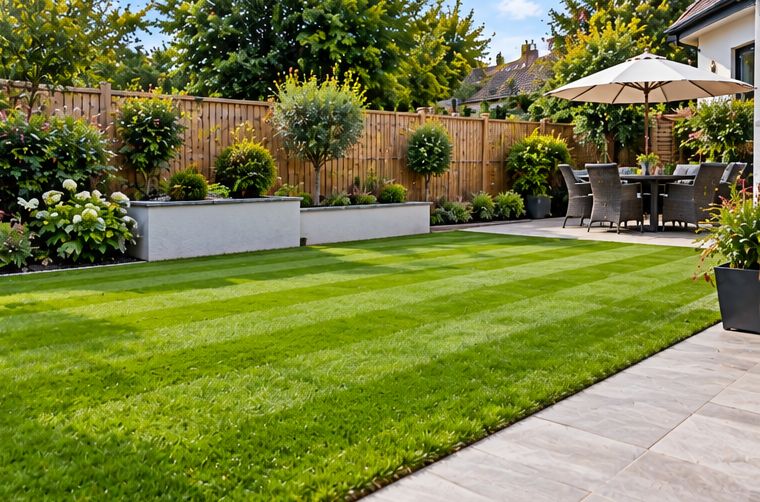
Topsoil and deliveries on a country lane
Where the soil is thin, a layer of good screened topsoil makes all the difference to how well a lawn roots and how it copes in dry spells. On a large area that can mean several lorry loads, so access matters. We check how a delivery will reach the property, whether a lorry can turn, and where soil can be tipped without blocking a lane or sinking into a soft verge.
Turf is a fresh, living product and should go down within a day or so of being cut. For a big lawn we order it in batches matched to how much can be laid each day, rather than having hundreds of rolls sitting stacked and yellowing in the yard.
Laying at scale
Rolls are laid in staggered rows, like brickwork, with the joints pushed tight and no gaps or overlaps. We work off boards so the prepared soil is not trodden into dips, and on slopes the rolls run across the slope so they are less likely to slip before they root.
Timing is everything on a Talgarth site. Autumn and spring usually give the best conditions, with moist, warm soil. Laying into frozen ground or during a dry spell in high summer makes the lawn much harder to establish. See gardens in the Black Mountains: planning for the weather for how the local climate affects timing.
Watering when the tap is a long way off
New turf needs regular watering until it roots, and that can be awkward when the lawn is a long way from the house. Plan it before the turf arrives: a long hose on a reel, an extra outside tap, a sprinkler that covers a wide area, or a rainwater butt near the far end. In a wet spell the weather will do most of the work; in a dry fortnight it will not.
Our article on watering and caring for new turf in the first six weeks explains how much, how often and when to stop.
Edges, fields and the first mowing season
Where a new lawn meets a field or a hedge, a clean edge stops rough grass and weeds creeping in. A mown strip, a timber edge or a gravel margin along the fence line all work, and they make strimming far quicker. Keeping livestock out while the turf roots is vital, so the fencing needs to be sound before the lawn goes down.
The first cut comes once the turf has rooted and the grass has grown a little, with the mower set high. After that, regular mowing and a sensible feeding plan keep it thick. How to look after a lawn through the year has a season-by-season guide.
Talk to T J Landscapes about your garden
Free quotes and honest advice across South Wales.
Questions People Ask
Can you lay turf on an old paddock?
Yes, but the ground usually needs more work than a garden: breaking up compaction, clearing weeds, removing stones and often adding topsoil. We assess it on the first visit.
Is it better to lay a big lawn in stages?
Often, yes. Laying one section at a time means each area can be watered properly while it roots. We plan the order so no finished area has to be crossed with machinery.
What affects the cost of a large lawn?
The area, the state of the ground, drainage work, how much topsoil is needed, access for deliveries, the amount of waste to remove and the choice of turf or seed. We set it all out in a free quote.
Can livestock go back on the area once it is turfed?
Not until the lawn is well rooted, and ideally not at all if you want it to stay a fine lawn. We can put up a fence or gate to keep the two apart.
How do we arrange a visit?
Tell us roughly how big the area is and what it is like now through the enquiry form, and we will come out to look at it with you.