
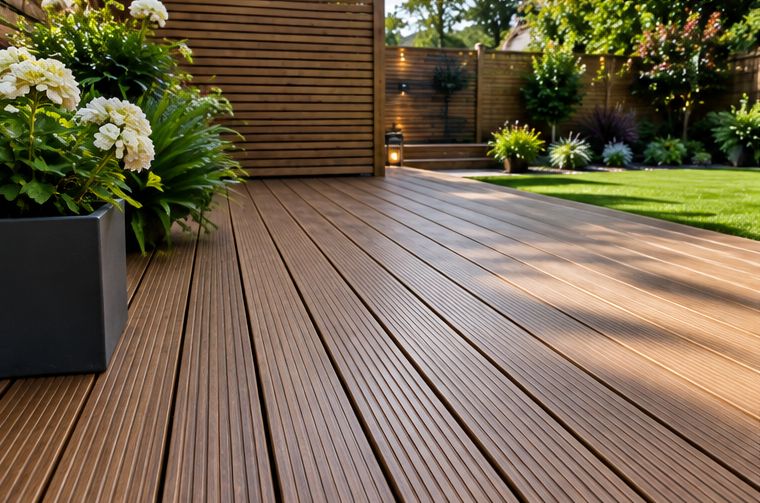
Composite decking has become one of the most common things people ask about when they plan a deck in Cardiff. The appeal is easy to see. A garden between high walls stays damp for much of the year, and a softwood deck in that kind of spot can turn green and slippery within a season or two unless it is scrubbed and treated regularly.
This guide looks at whether composite is worth it for a typical Cardiff garden, what to watch out for and how it is built. If you want the straight comparison of materials first, read our general guide on composite or timber decking for a South Wales garden. For our wider work in the city, see landscaping in Cardiff.
What composite boards actually are
Composite decking boards are made from a mix of wood fibre and plastic, formed into solid or hollow boards. Most good-quality boards now have a tough outer shell, often called a cap, which protects the core from staining, fading and moisture. Older and cheaper uncapped boards can mark and fade more easily.
The boards sit on a frame just as timber boards do. They do not need painting, staining or oiling, and they do not rot or splinter in the way softwood can. That is the main reason people choose them.
Why composite suits many Cardiff gardens
The gardens where composite makes most sense are the ones where timber struggles, and there are plenty of those across the city. A few situations come up again and again:
- Shaded terrace yards where the sun barely reaches the ground in winter, so timber never dries out properly.
- North-facing suburban gardens where a deck by the house would sit in the shadow of the building most of the day.
- Busy households that want a deck they can sweep and hose down, not one that needs treating every spring.
- Rented or soon-to-be-sold homes where a low-maintenance finish helps the garden stay presentable.
Composite is not immune to grime. Algae and leaf litter can still build up on any surface in the shade, but on capped boards it usually washes off with a brush and warm soapy water. Our guide on how to stop decking going slippery covers cleaning and grip.
Where composite falls short
It is worth being honest about the downsides before you decide. Composite usually costs more to buy than treated softwood, so the saving comes over the years in upkeep rather than on day one. Darker boards in full sun can get hot underfoot on a summer afternoon, which matters if children play barefoot.
Some people also find composite looks less natural than timber, although the better ranges have convincing grain and colour variation. Boards expand and contract with temperature, so they have to be fixed with the right gaps and the manufacturer's clips, not simply screwed down. And the frame beneath is often still timber, so it has to be built properly to last as long as the boards.
Levels, air bricks and what goes underneath
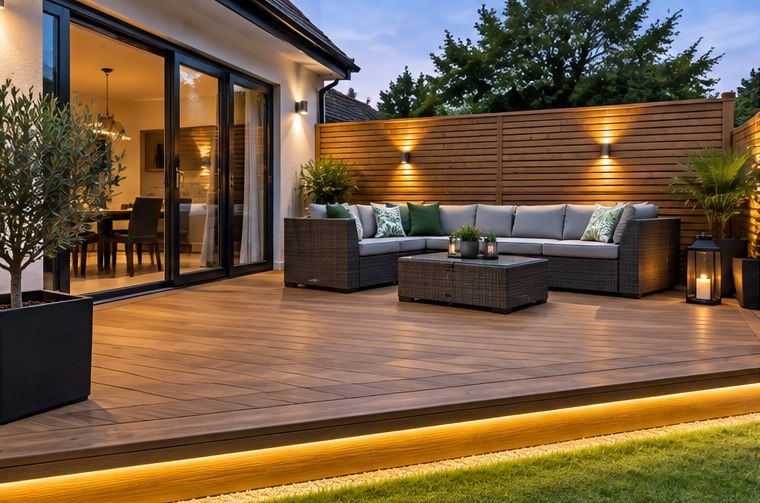
Many older Cardiff houses have suspended timber ground floors, ventilated by air bricks low in the outside walls. A deck built against the house must never block those air bricks or sit above the damp proof course, or damp problems can follow indoors. In practice that often means a low deck set a step down from the back door rather than one flush with the kitchen floor.
Below the frame, the ground needs to drain. In a walled yard with no soil left, we check where rainwater will run once the deck is down and make sure it cannot pond underneath. A weed membrane and a layer of gravel keep growth down, and leaving a gap around the edges keeps air moving, which helps the frame last. If you want to cover an old concrete yard, our guide on building decking over an old patio or concrete explains when that works.
Designing a deck for a small city garden
In a narrow yard, the direction of the boards changes how the space feels. Boards running across the width make it look broader; boards running away from the house draw the eye to the far end. A picture-frame border in a contrasting colour gives a neat edge and hides the cut ends.
A deck does not have to fill the whole garden. A platform at the sunny end with a paved path to the house, or a deck combined with raised beds, often works better than wall-to-wall boards. Our article on making the most of a small Cardiff terrace garden has more on zoning a small space.
Getting long boards into a terrace
Composite boards come in long lengths, and they are heavy and flexible. In a Cardiff terrace with no rear lane, getting them through the front door, down the hall and round the kitchen is part of the planning. Sometimes they can be passed through a front window or over a back wall with a neighbour's agreement; sometimes shorter boards are ordered and the joins are designed into the pattern.
We measure the route on the first visit so the right lengths arrive and nothing is damaged on the way in. That is the kind of detail that makes the difference between a smooth job and a frustrating one.
So is it worth it?
For a shaded, damp garden where you want a deck you can mostly forget about, composite is usually worth the extra outlay. For a sunny, open plot where you enjoy the look of real timber and do not mind an annual treatment, a good softwood or hardwood deck may suit you better.
Tony and the team build both, and we are happy to show you samples and talk through what suits your garden. See our garden decking page, or ask for a free quote.
Talk to T J Landscapes about your garden
Free quotes and honest advice across South Wales.
Questions People Ask
Does composite decking go slippery in shade?
Capped composite is generally more grippy and easier to clean than softwood, but no outdoor surface is completely slip-free in a damp, shaded Cardiff yard. Regular brushing keeps algae and leaves from building up.
How long does composite decking last?
Good capped boards on a well-built frame should last many years with little upkeep. The frame is often the part that decides how long the deck lasts, so it must be built with airflow and good fixings.
Can composite decking go right up to the back door?
Only if it stays below the damp proof course and keeps air bricks clear. In older houses that usually means a step down from the door, which we plan in from the start.
Does composite decking get hot?
Darker boards in full sun can get warm to the touch. In a shaded garden it is rarely an issue, and lighter colours stay cooler.
Can you remove an old timber deck first?
Yes. We lift old boards and frames, clear the ground and take the waste away, then build the new deck. If the old frame is sound, we will tell you, but it is usually better to start again.