
With so many Caerphilly households running two cars and heading down to Cardiff each morning, the front of the house works hard. On older semis the original drive was often built for one small car, and the path to the door is cracked concrete. On newer estates the parking space may be fine, but the paths around the side and back are narrow, loose or missing altogether.
This guide covers the practical side of paving the front and sides of a Caerphilly home: how wide to go, how to deal with slopes and rainwater, which surfaces work, and what to check with the council before we start. For the back garden, our patio or decking guide is the better place to begin.
Measure for the cars you will actually own
A drive that fits one car with the doors shut is not the same as one you can comfortably get in and out of with shopping and children. Before choosing materials, park up, open the doors fully and measure. Allow room to walk past a parked car to the front door, and think about where the bins will live.
On many interwar and post-war semis around Caerphilly, widening means taking out part of a front lawn, a low wall or an old hedge. That is usually straightforward, but it changes how the front of the house looks, so we plan the new edge, any remaining planting and the line of the path at the same time.
Falls, slopes and where the rain runs
Some Caerphilly streets rise towards the hills around the town, so drives can slope towards the house or away from it. Either way, rainwater has to be sent somewhere sensible. A drive that falls towards the front door needs a channel drain across the bottom; one that falls to the road should not dump a sheet of water onto the pavement.
Paving next to the house must also sit safely below the damp-proof course, with a fall away from the walls. On older properties where the ground has been built up over the years, this can mean digging the level down before the new surface goes in.
- A gentle, even fall across the whole surface so water never ponds.
- Channel drains where the paving meets the house or a garage door.
- Water directed to a border, soakaway or suitable drain, not to next door.
- Steps or a gentle ramp where a path climbs too steeply to walk safely in the wet.
Block paving, slabs or gravel
For a drive that takes the weight of cars, block paving is the most common choice on Caerphilly estates. Small blocks spread the load, can be lifted and relaid if a service needs digging up, and come in permeable versions that let rain soak through the joints. Our guide Block Paving Driveways: What to Ask Before You Book lists the questions worth asking any installer.
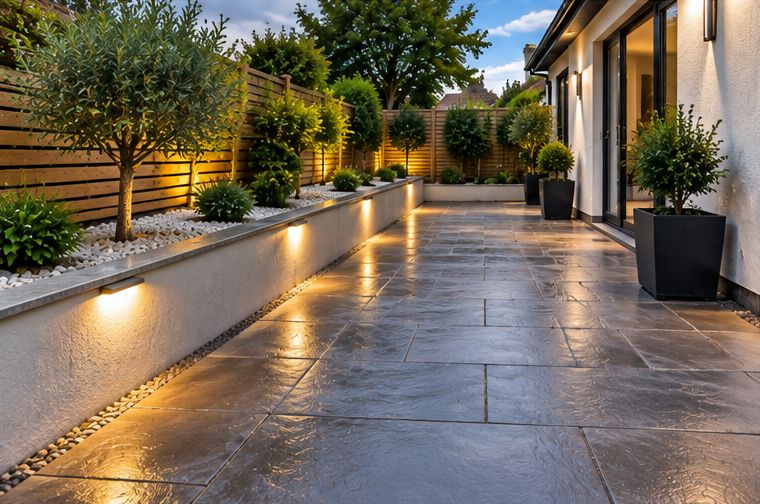
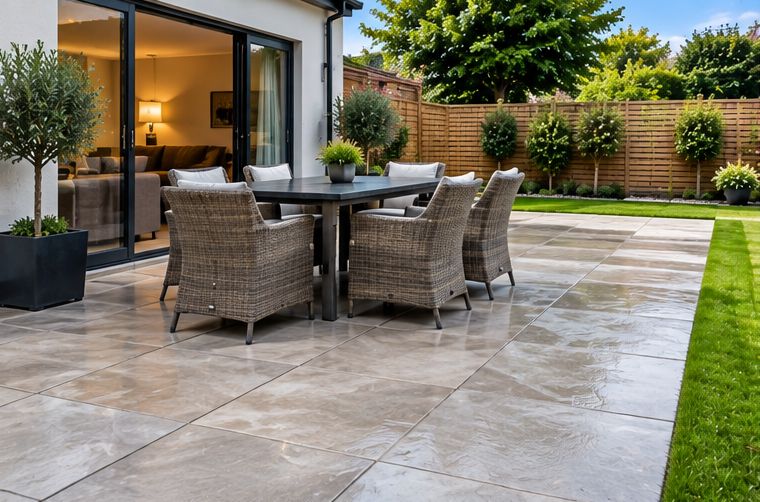
Slabs suit paths, side passages and a pedestrian approach to the door, and can match a patio at the back so the house feels joined up. Thicker, well-bedded slabs can take a car in some cases, but blocks are usually the safer bet where tyres will turn. Bound or loose gravel is another option for a drive, provided it is edged firmly so it does not end up on the pavement.
The part nobody sees
When a drive in Caerphilly sinks or ruts, the blocks are rarely to blame. It is far more often because the ground was not dug out deep enough, the sub-base was thin or poorly compacted, or the edges were not restrained. On clay ground, which is common around the town, a weak base will move as the soil wets and dries.
A proper job means digging out to a firm formation, laying and compacting a hardcore sub-base in layers, and setting a solid concrete-haunched edge before the surface goes on. The same principles apply to paths, just to a lighter spec. You can read how we build the layers in how a patio should be laid, and why poor bases lead to trouble in why patios sink, crack or lift.
Side paths and back access on semis
The strip of ground down the side of a semi is often the most neglected surface in the garden, yet it carries bins, bikes and every bag of compost you ever buy. Replacing broken concrete with a level, well-drained path, and adding a sturdy side gate, makes the whole garden easier to use. Our fencing work in Caerphilly includes gates to finish the job.
On newer estates the problem is often the opposite: no proper path at all, just a strip of stones between the house and the fence. A narrow slabbed or block path, set with a fall away from the house, keeps feet dry and stops the gravel wandering onto the lawn.
Check permission before the digger arrives
Paving a front garden is not always as simple as it looks. Rules on surfacing front gardens depend on the area involved and on whether rainwater drains to a permeable surface or runs off onto the road. A new or widened dropped kerb also needs the council's agreement, and some newer estates in Caerphilly have covenants about front gardens and parking in the deeds.
We are landscapers, not planners, so the safest advice is to check with Caerphilly County Borough Council, and your deeds, before work starts. Choosing a permeable surface, or sending rainwater to a border or soakaway on your own land, often keeps things simple. We are happy to explain the options we can build.
Getting a quote
The things that shape the price of a drive or path are its size, the depth of dig needed, how much spoil has to go, the ground conditions, the surface you choose and any drainage or walling. See the materials we lay on our patio slabbing and paving page and our patio paving in Caerphilly page, or read more about our local work on our Caerphilly landscaping page. When you are ready, get in touch and Tony and the team will come and measure up for a free quote.
Talk to T J Landscapes about your garden
Free quotes and honest advice across South Wales.
Questions People Ask
Do I need planning permission to pave my front garden in Caerphilly?
It depends on the size of the area and how the rainwater is dealt with. Permeable surfaces, or water sent to a border or soakaway on your own land, are often treated differently from solid paving that drains to the road. Check with Caerphilly County Borough Council before work starts.
Can you widen my drive if the kerb is not dropped?
We can build the drive, but you need the council's agreement for a new or wider dropped kerb before you drive across the pavement. It is worth applying early, as it can take a while.
Will block paving cope with clay ground?
Yes, as long as it is built on a properly dug and compacted sub-base with firm edges. Clay moves as it wets and dries, so a thin base is where most problems start.
Can the path match my patio at the back?
Often, yes. Using the same slab or a matching edging for paths and the patio makes the property feel joined up. Where a surface has to take cars, we may suggest blocks in a colour that sits well with the slabs.
How long does a new driveway take?
It varies with the size, the dig and the drainage needed. Once we have seen it we can give you a realistic timescale along with your free quote.