
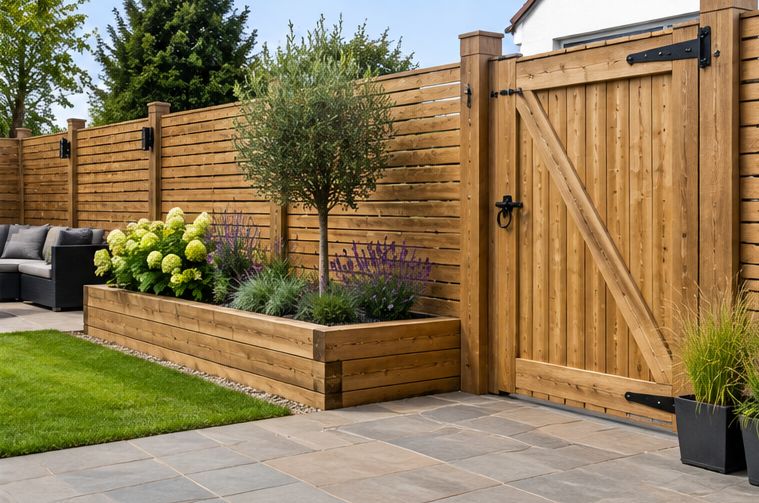
On a flat plot a fence is a straight run of posts and panels. On the stepped terraces of Abertillery it rarely is. The boundary between two back gardens may drop steeply from the house to the lane, the ground on each side may sit at different heights, and there is often an old wall or bank somewhere along the line.
This guide covers the practical choices: how a fence follows a slope, what the posts need, when a fence should not go on top of a wall, and how the lane gate fits in. For the styles we fit, see our fencing and gates page, and for the wider picture in the town, our landscaping in Abertillery page.
Two slopes to think about
The first slope is the obvious one: the ground falling down the length of the garden. The second is easier to miss. In a terraced row, your garden and the one next door may have been levelled at different times, so one side of the boundary can sit higher than the other.
Where there is a difference in level across the line, the fence is no longer just a screen. The lower side may need a gravel board or a small retaining edge so soil does not push through, and the posts need to be set deeper to cope with the extra load.
Stepped panels
Stepping means each panel is fixed level, and each one sits a little lower than the last as the fence goes down the hill. It suits standard panels and gives a neat, tiered look that matches stepped terraces well.
The drawback is the triangular gap left under each panel on the downhill side. That is filled with a gravel board cut to the slope, a low wall or planting. On a steep Abertillery plot the steps can be large, so we usually plan the post spacing to keep them even and avoid awkward gaps.
Raked close board
Raking means the rails follow the angle of the ground, and the vertical boards are fixed to them so the top of the fence runs parallel to the slope. The result is a smooth line with no gaps at the bottom, which suits steady slopes and the long, narrow boundaries typical of the town.
Close board fencing is built on site, so it adapts to changes in angle along the run. It is also sturdy, which helps in exposed spots higher up the valley side. Our guide to close board, panel or slatted fencing compares the main styles.
- Stepped: tidy tiers, works with panels, needs the gaps filled
- Raked: smooth line, no gaps, built board by board
- Mixed: raked on the steep part, stepped where the ground levels off
Posts on a hillside
Posts on sloping ground are pushed by the wind like any other, but also by soil creeping downhill and by water running along the line. They need to go in deep and be set in concrete, with the top of the concrete shaped to shed water away from the timber.
Concrete posts with gravel boards last well in wet ground, while treated timber posts look softer and are easier to cut to odd heights. Both can work in Abertillery if they are set properly. See concrete posts or timber posts for a garden fence for the pros and cons.
When the boundary is an old wall
Many boundaries in terraced gardens already have a wall along them, and it is tempting to bolt a fence on top for extra height. A fence catches a lot of wind, and that force is passed straight into the wall. An old retaining wall that is already holding back the hill may not cope with it.
If the wall is sound, a light trellis or low screen is usually fine. For anything taller, it is often better to set the posts just behind the wall in their own concrete, or to rebuild the wall first if it is leaning. Replacing a collapsing garden wall in Abertillery explains the warning signs, and our brickwork and garden walls page covers the rebuild.
The gate to the rear lane
The fence line usually ends at the lane, and the gate there does a lot of work: bins, bikes, deliveries and, during a landscaping job, every barrow of materials. A lane gate on a slope needs posts strong enough for its weight, hinges that let it swing clear of the rising ground, and a good bolt or lock. A small level pad of paving or concrete either side of the gate stops it becoming a muddy step in winter.
Make sure it is wide enough for a wheelbarrow and your bins, and think about which way it opens so it does not swing out into a shared lane. Our guide to choosing and fitting a garden gate goes into more detail.
Height, neighbours and permission
As a general guide, garden fences up to about two metres high at the back of a house usually do not need planning permission, but lower limits apply next to a road or lane used by vehicles, and on a slope, or where the ground differs on each side, it is less obvious how the height should be measured. Rules can also differ for listed buildings and in some other circumstances, so check with Blaenau Gwent Council if you are unsure. We are landscapers, not planners.
It is also worth agreeing the line and style with your neighbour before anything goes up, especially where the fence replaces a shared one. When you are ready, ask Tony and the team for a free quote.
Talk to T J Landscapes about your garden
Free quotes and honest advice across South Wales.
Questions People Ask
Which side of the fence should face my garden?
Traditionally the smooth face goes towards the neighbour and the posts and rails face the owner, but many people now agree it between them. On a shared boundary in Abertillery, where neighbours often see both faces from their stepped terraces, it is worth settling this together before any posts go in.
Can you fence a boundary where there is no rear lane access?
Yes. Panels, posts and concrete can come through the house with the floors protected, though it takes more trips. We will look at the route during the free visit.
Why has my old fence started leaning downhill?
Usually because the posts were not set deep enough, have rotted at ground level, or the soil around them has moved on the slope. Our guide on fence repair or replacement helps you decide what to do.
How long does a fence on a sloping plot take to put up?
A slope adds time because each post has to be set to its own height and each panel or rail cut to fit. The length, the ground and the access all affect it, and we give you an idea of timing with the quote.
What affects the cost of fencing a sloping garden?
The length and height of the run, how steep it is, the style of fence, the post type, any retaining gravel boards, removal of the old fence and access from the lane. We give a free quote after seeing it.