
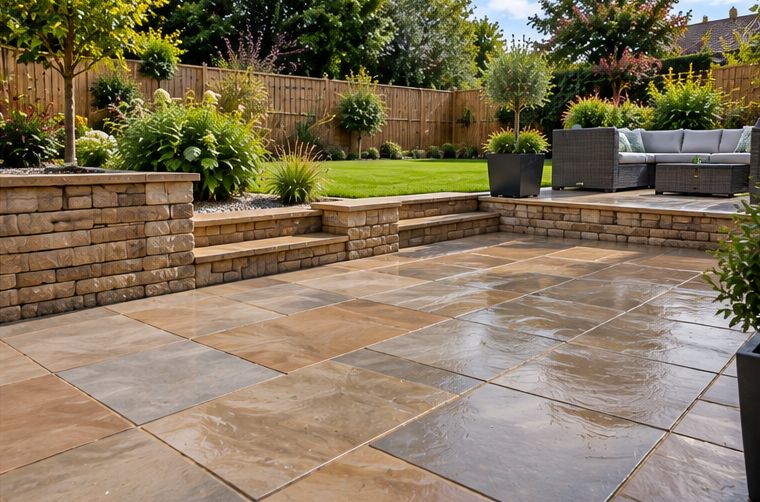
Look over the back of almost any terrace in Pontypool and you will see retaining walls: old stone walls holding up the garden above, brick walls built when a yard was levelled, block walls from the last few decades and the odd row of timber sleepers. Some are doing their job perfectly well after a century. Others are bowing, cracked or shedding stones onto the path.
This guide explains how a retaining wall works, what goes wrong, and what we consider when building a new one on a Pontypool slope. It sits alongside our guide on how to terrace a steep Pontypool back garden, which covers the bigger layout, and our landscaping in Pontypool page.
A retaining wall works harder than it looks
A free-standing garden wall only has to stand up. A retaining wall has soil pressing against one side of it all the time, and that pressure rises sharply when the soil is wet. On a valley side, where water drains down through the ground after every heavy shower, the load behind a wall can change a great deal from week to week.
That is why the height of the ground being held back matters so much. A wall retaining knee-height of soil is a very different structure from one holding back the height of a person, even if the two look similar from the patio.
Why so many older walls in the town are struggling
Many of the walls behind Pontypool terraces were built without a footing in the modern sense and without anything to let water out. Over the years, ground has been raised behind them for lawns and sheds, trees have grown close by, and paths have been laid along the top. Each change adds a little more load.
- A lean or bulge in the face, usually worst in the middle of a run.
- Cracks that widen or stepped cracking through the mortar joints.
- Wet patches and staining near the base, showing water trapped behind.
- Loose coping or stones falling from the top.
- Ground sinking along the high side of the wall.
Any of these is worth having looked at. If a wall is moving and there is a path, a neighbour’s garden or a building close to it, keep people and heavy loads away from it until it has been assessed.
Brick, block, stone or timber
The right material depends on the height, the look you want and what sits nearby.
- Brick gives a neat finish that suits a patio by the house, and can be matched to the home. Our guide to choosing bricks and coping explains the options.
- Concrete block, rendered or faced, is strong and economical for taller walls, and can be reinforced where a design calls for it.
- Natural stone sits well beside old Pontypool terraces and older boundary walls, either as a solid wall or as a facing on a block core.
- Timber sleepers are quick and informal, and good for lower terraces and raised beds, though they have a shorter life than masonry.
The footing: the part nobody sees
Every masonry retaining wall needs a concrete footing wide and deep enough for its height, set on firm ground below the soft topsoil. On a slope the footing may need to step down in levels, like the wall itself, so that it always bears on solid ground.
Valley ground can change from firm clay to loose fill within a few metres, especially in gardens that have been altered over the years. We dig until we reach ground that will carry the wall, rather than stopping at a set depth. Our guide to garden wall foundations covers this in more detail.
Letting the water out
Drainage is what separates a wall that lasts from one that bows within a few winters. Behind a new wall we place a layer of clean, free-draining stone, usually with a perforated pipe along the base to carry water away. Weep holes through the lower courses give any water that does build up a way out.
Where a lot of water comes down the hillside, it may also need catching further up the garden, before it reaches the wall. We look at where the water goes on a wet day as part of the visit; a photo of the garden after heavy rain is often more useful than one on a sunny afternoon.
When a design is needed
Taller walls, walls supporting a path, driveway or building, and walls on a boundary with a big difference in ground level between gardens may need to be designed by a structural engineer. We will tell you honestly if we think your wall falls into that category, and we can build to an engineer’s design. The engineering advice guide sets out the usual triggers.
Boundary walls can also involve neighbours and, in some cases, party wall rules. Speak to the neighbour early, and take advice from a surveyor or solicitor if ownership is unclear. Where a wall is next to a road or footpath, check with Torfaen County Borough Council before rebuilding.
Repair or rebuild?
A wall that is sound but has tired joints can often be repointed. A section that has bulged may be taken down and rebuilt on a new footing, reusing the original stone or brick where possible. A wall that has been overloaded for years is sometimes better replaced entirely with one built for the job. We explain the options, and the reasons, when we see it. Our brickwork and garden walls page shows the rest of our masonry work, and you can arrange a visit through the enquiry form.
Talk to T J Landscapes about your garden
Free quotes and honest advice across South Wales.
Questions People Ask
How high can a sleeper retaining wall be?
Sleepers suit lower walls best. As walls get taller, the forces behind them increase quickly, and masonry or an engineered design becomes the safer choice. We will advise on your particular slope.
Can you fit a fence on top of a retaining wall?
Often, if the wall is strong enough and the fixings are planned in. The fence adds wind load, so it needs thinking about at the design stage. See new garden fencing in Pontypool.
What affects the cost of a retaining wall?
Its height and length, the material, the depth of footing needed, drainage, how much soil has to be dug out or brought in, whether an old wall has to come down first, and access. We give a free quote after seeing the site.
Is it safe to use the garden while the wall is being built?
We fence off open excavations and ask that children and pets stay clear of the work area. Once the wall is finished and backfilled, the garden is safe to use.
Can a retaining wall be planted?
Yes. A wall with a planted bed along the top, or trailing plants in pockets on the face of a stone wall, softens a hard edge in a Pontypool garden. Keep large shrubs and trees back from the wall, though, as their roots can push against it over time.
Do you take away the soil and old masonry?
Yes. Surplus soil, rubble and old wall material are removed as part of the job, unless we are reusing stone in the new wall.