
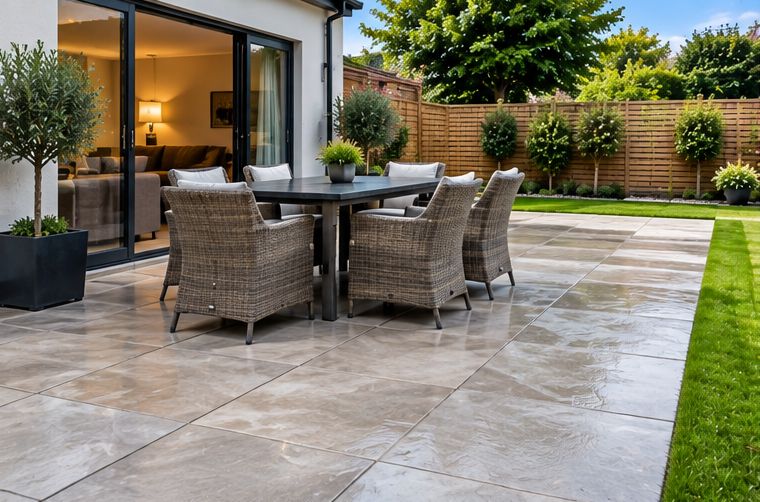
Walk down any of the older streets in Pontypool and the back yards follow a pattern. There is a strip of hard ground by the kitchen, usually cracked concrete or a few tired slabs, then the garden rises or drops away behind it. That strip carries the bins, the washing, the bikes and, on a good evening, a table and chairs. Relaying it is one of the most common jobs we are asked to quote for from our base on Conway Road.
This guide looks at what is particular about slabbing a terraced yard in Pontypool. For the technical detail of sub-bases and bedding, read how a patio should be laid, and for the wider picture of our work in the town, see landscaping in Pontypool.
What is usually under the old yard
The old concrete behind a Victorian terrace has often been patched, extended and resurfaced several times. Lifting it can reveal anything from a neat layer of hardcore to buried brick, old drains and the footings of outbuildings that disappeared decades ago.
We break it out, sort what can stay from what has to go, and take the waste away. Once the ground is exposed we can see how firm it is and whether any soft spots need digging out and replacing before the new base goes down. It is not glamorous work, but a slabbed patio is only as good as what is underneath it.
The back door, the damp course and the fall
The most important level on a terraced patio is the one against the house. The finished paving needs to sit comfortably below the damp proof course so that rain splashing off the slabs does not soak the wall. On older houses the damp course can be hard to spot, so we look for it carefully before setting any heights.
The patio also needs a gentle fall so that water runs away from the building, towards a gully, a drain or a planted area that can take it. On a narrow yard this sometimes means falling sideways rather than back, because the garden behind rises up. Getting that right is the difference between a patio that dries quickly and one that holds puddles by the back step.
Shade, damp and choosing the slab
Many Pontypool yards sit between high walls and the house next door, and on a valley side they can lose the sun for much of the day in winter. That means paving stays damp for longer, and some surfaces turn green or slippery faster than others.
- Porcelain absorbs very little water, cleans easily and is a good choice for a shaded yard, as long as a textured, outdoor-rated slab is chosen. See porcelain paving.
- Indian sandstone has a natural riven texture that grips well, though it needs sealing or regular cleaning where it stays wet. See Indian sandstone paving.
- Concrete slabs are practical and hard-wearing, and suit a working yard where bins and bikes are moved about.
Our guide which patio paving copes best with Welsh rain compares these in more depth.
Getting slabs into a mid-terrace
Where there is no rear lane, everything comes in through the front door and out through the kitchen. Slabs are heavy and awkward, and large-format porcelain can be tricky to carry through a narrow hallway. We look at the route when we visit, protect floors and door frames, and sometimes suggest a slab size that makes the carry more manageable without spoiling the look.
If there is a lane at the back, we plan deliveries so that the lane is not blocked for long. Either way, access is something we factor into the quote rather than discovering on the day.
Making a narrow space feel bigger
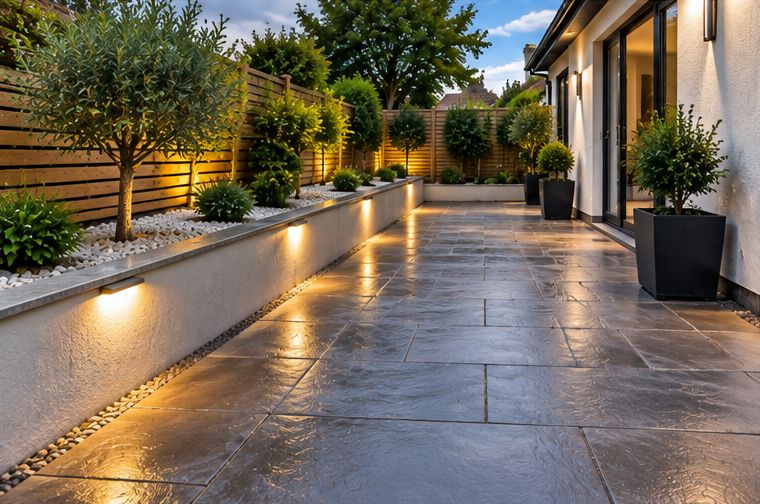
A small yard can look much more generous with a few simple choices. Laying slabs across the width rather than along the length makes a narrow strip feel wider. A single colour of paving, carried right up to the boundary, looks calmer than several patched materials. A low brick planter or raised bed along one side softens the walls without taking up much room.
If the garden rises behind the patio, the step up to the next level can become a feature in its own right, with a matching stone tread and a planted edge. That is where the paved yard starts to join up with the rest of the garden; our guide to garden steps and paths for Pontypool hillside homes picks up from there.
Pointing that stands up to a wet valley
The joints between slabs take a lot of punishment in Pontypool. Rain runs down off the garden above, leaves collect in the corners, and a joint that cracks soon fills with moss and weeds. We point with a mortar or a jointing compound suited to the slab, filled flush so that water runs over it rather than sitting in it.
Porcelain generally needs tighter, neater joints than sandstone, and some jointing products need a dry spell to go off properly. In a damp autumn that can mean waiting a day for the right weather rather than rushing the finish. It is a small delay that saves a lot of weeding later.
Drains, manholes and shared paths
Terraced yards often have a manhole cover, a gully or a shared drain run close to the house. These have to stay accessible. We can fit a recessed cover that takes a slab so it blends in, or neatly cut the paving around it.
Some rows also have shared rights of way along the backs of the houses. If a path or passage is shared with neighbours, it is worth talking to them before changing its level or surface, and checking your deeds if you are not sure where your boundary runs.
Talk to T J Landscapes about your garden
Free quotes and honest advice across South Wales.
Questions People Ask
Can you lay new slabs over my old concrete yard?
Occasionally, if the concrete is sound, level and low enough. In most Pontypool yards it is cracked or already close to the damp course, so it is better to break it out and start again with a proper base.
What affects the cost of a new patio?
The size of the area, how much old concrete has to come up, the ground underneath, the slab you choose, drainage, any steps or walls, and access to the back. We explain all of this in a free quote once Tony has seen the yard.
How do I stop the new patio going green?
Good falls help it dry, and a slab that suits shade helps too. Regular sweeping and an occasional clean do the rest. Our guide on looking after a new patio has more.
Can you extend the patio up the garden?
Yes. Where the ground rises we can terrace it and carry the paving up in levels, with walls and steps between them. Read how to terrace a steep Pontypool back garden for how that works.
How long does a small yard take?
Most small terraced yards take a few days, depending on how much has to come out, the access and the weather. We give you a realistic idea of timing when we quote. See our patio slabbing and paving page for the full range of work.