
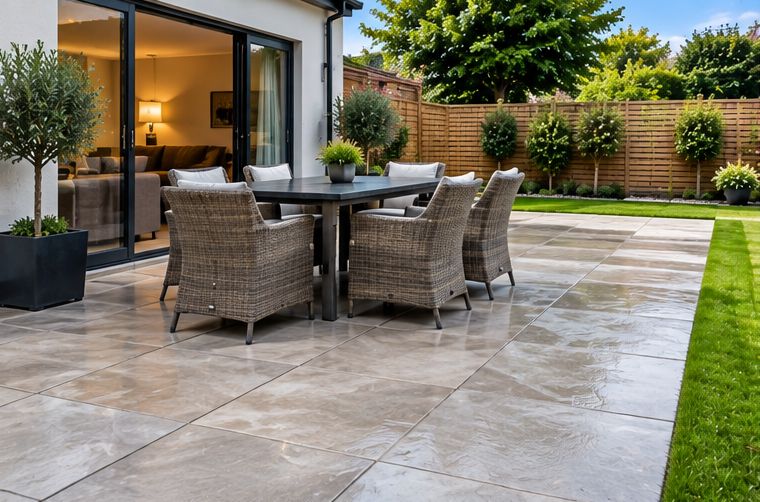
Very few back yards in Tonypandy are flat. The terraces were built along the side of the Rhondda Fawr valley, and the space behind each house usually rises towards the lane or drops away from it. Old concrete, cracked slabs and a patch of mud by the back door are what many people inherit.
This article looks at how to pave that kind of yard so it is level where you need it, safe underfoot and able to shed the heavy valley rain. It does not repeat the general guides on bases and materials; it links to them where they help. Our patio slabbing and paving page shows the work we do, and the landscaping in Tonypandy page sets it in context.
Measure the fall before you choose anything
The first job on any sloping Tonypandy yard is finding out how much it actually drops, and in which direction. A string line and a spirit level, or a laser level, tell you the difference in height between the back door and the far wall. It is often more than it looks.
That number shapes the plan. A small fall can be taken out by raising or lowering the paving a little. A large one needs steps, a retaining edge or a split into separate levels. It also tells you roughly how much soil will have to come out or go in, which matters a great deal when every bag goes through the back lane.
Three ways to handle the slope
There is no single right answer, but most sloping yards in the town end up with one of these approaches.
- One level area and steps: a flat patio by the house with steps up or down to the rest of the yard. Simple, and good for bins and washing.
- Two or three terraces: the yard is split into level platforms held by low walls, each used for something different. More groundwork, but far more usable space.
- A gentle ramp: where the fall is modest, the paving can follow a slight gradient all the way to the lane. Ideal for pushing bins, buggies or a wheelchair.
The terraced option usually needs small retaining walls. Our guides to garden steps in brick and stone and rebuilding a back wall in a Tonypandy terrace cover the masonry side.
Where does the water go?
Rain falling on a hillside terrace does not stop at your boundary. Water runs off the lane or the yard above, joins what falls on your own paving and heads downhill. If the yard slopes towards the house, that means towards the back door and the airbrick.
Paving should always fall gently away from the building. Where the natural slope runs the wrong way, the patio next to the house is set so it drains across the yard, and a channel drain or gully at the low point takes the water to a soakaway or an existing drain. Surface water from a steep lane can also need a drain across the gateway. Our general article on stopping a garden waterlogging explains the options.
Choosing slabs for a wet valley yard
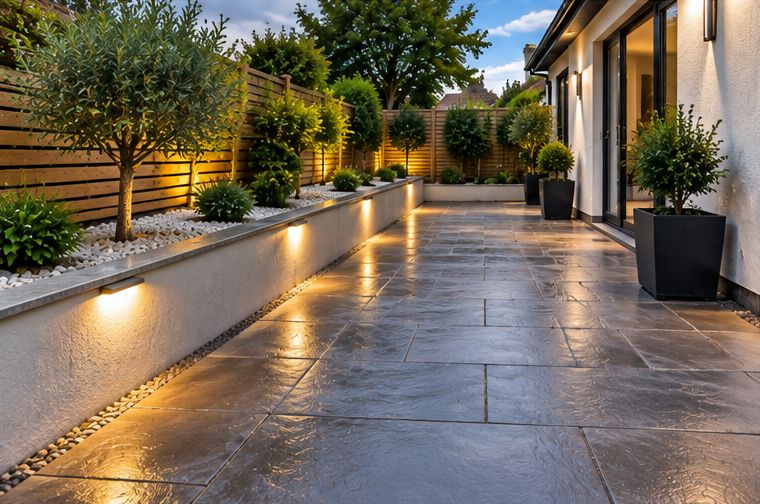
The Rhondda gets a lot of rain, and a shaded terrace yard can stay damp for days. That favours paving with some grip and a surface that does not hold algae easily. Textured porcelain, riven sandstone and good concrete flags all work if they are laid properly; very smooth finishes can get slippery on steps.
Smaller units, such as setts or smaller slabs, also cope better with the odd shapes and short runs you get in a narrow yard, and they are easier to carry through a lane. See which patio paving copes best with Welsh rain and porcelain, sandstone or concrete for the comparison.
Levels next door and at the damp course
In a terrace, your yard is bordered by two others, and the ground on each side may not match yours. Raising paving against a shared wall can push soil and water towards a neighbour, and lowering it can undermine an old wall footing. We look at both boundaries before settling the finished height.
The house matters too. Paving next to the back wall should finish at least two brick courses below the damp-proof course where possible, so rain cannot splash above it. On a yard that climbs steeply away from the house, that sometimes means a small drop or channel right by the door, with the rise taken up further out.
What is under the old concrete
Many Tonypandy yards have been concreted over at some point, and lifting that concrete is often the biggest part of the job. Underneath there may be coal ash, old brick, clay or the remains of an outside toilet or coal store. None of it makes a good base.
We dig out to firm ground, lay a compacted sub-base and bed the paving on a full mortar bed with the right falls. That is what stops a patio sinking or rocking later on. The details are in how a patio should be laid, and why patios sink, crack or lift shows what happens when that step is skipped.
Getting it all in and out through the lane
A sloping yard usually means moving a lot of material: broken concrete and spoil out, sub-base, sand, cement and slabs in. In Tonypandy that almost always happens through the rear gate, so we check how close a vehicle can get, whether the lane is shared or steep, and where waste can be loaded without blocking neighbours.
It is also worth planning the gate at the same time, since the paving often finishes at it. Fencing and gates onto a Tonypandy back lane covers that side, and our patio paving in Tonypandy page shows the finished result we aim for.
Talk to T J Landscapes about your garden
Free quotes and honest advice across South Wales.
Questions People Ask
Can a steep Tonypandy yard be made completely flat?
Sometimes, but it often means building a tall retaining wall and moving a lot of soil through the lane. Two shorter levels joined by steps are usually more practical and just as usable.
Why does water pool by my back door?
Usually because the yard, or the old concrete on it, falls towards the house, or because water from the lane above is running in. New paving should fall away from the building and have a drain at the low point.
Is it worth keeping the old concrete and paving over it?
Only if it is sound, well drained and at the right height, which is rare in older Tonypandy yards. Laying on top raises the level, which can bring it too close to the damp course, so we usually recommend lifting it.
Which paving is safest on steps in the rain?
A textured or riven surface with a clearly marked nosing on each step. Keep steps an even height and add a handrail where the drop is steep.
What affects the cost of paving a sloping yard?
How much the ground falls, whether walls or steps are needed, how much old concrete comes up, the drainage, the paving you choose and how easy the lane access is. Tony will go through each in a free quote, so get in touch.