
Walk the lanes behind almost any row of houses in Tonypandy and you see the same shape of garden repeated: narrow, longer than it is wide, climbing or dropping with the valley side, and finished off by a wall and a gate. Many of them are used for one thing only, usually getting the bins out.
This guide is about changing that. It is not a list of products. It is a way of thinking about a small plot so that it holds a seat, some storage, a bit of green and a safe path without feeling crowded. For the wider picture of the work we do locally, see our landscaping in Tonypandy page, and for the design side in general, our landscaping and garden design service.
Start with a list of jobs, not a picture
Photos of show gardens are not much help in a Rhondda terrace. A more useful first step is to write down everything the space has to do in a normal week. For most households that is some mix of the following.
- Somewhere to sit with a drink when the sun reaches the yard
- Room for two or three wheelie bins and a recycling box
- A washing line or rotary dryer
- A dry place for tools, a bike or a lawnmower
- Something growing, even if it is only a few pots of herbs
- Safe footing between the back door and the lane gate
Put the busy jobs nearest the house
Once the list exists, give each job a place. The things you do every day, such as reaching the bins or hanging washing, belong close to the back door and along the path. The things you enjoy now and then, like sitting out, can go wherever the light is best, which in a Tonypandy garden is often the top end, furthest from the house and away from the shadow of the rear wall.
Thinking in zones stops everything piling up in the one flat spot outside the kitchen. It also tells you where the level areas need to be before a single slab is ordered.
Deal with the slope once
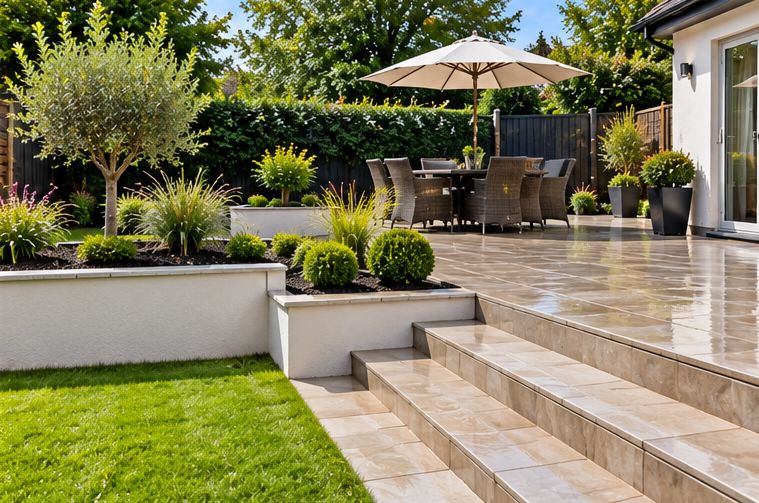
Most Tonypandy plots fall one way or the other, and the slope decides almost everything else. Rather than fighting it with lots of small, awkward steps, it usually pays to make two or three clear levels, each big enough to be useful, joined by proper steps with an even rise.
Each level can then have its own job: bins and washing on the lowest, a seat on the middle one, planting at the top. Our guide to landscaping a sloping valleys garden explains the principles, and paving a sloping Tonypandy back yard covers the hard surfaces in detail.
Storage that hides in plain sight
Clutter is what makes a small garden feel smaller. A slim timber bin store with a lid you can plant on, a narrow shed set tight against a side wall, or a bench seat with a lift-up top all take things off the floor without eating into it.
Tuck storage into the corners you would not sit in anyway, such as the shady strip beside the back extension or the space either side of the lane gate. Keep the doors facing the path so you are not squeezing past planting to reach them.
Grow upwards and along the edges
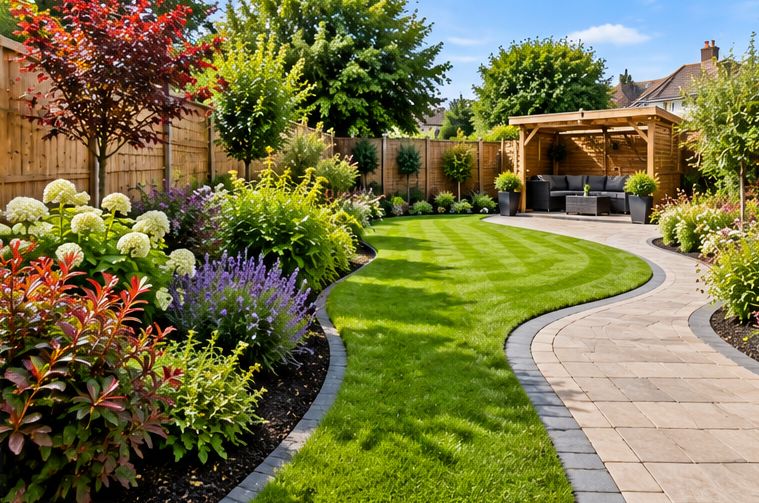
In a narrow plot the walls and fences are the biggest planting space you have. Trellis panels with climbers, wall-mounted troughs and a run of sleeper raised beds along one side give plenty of green while leaving the middle clear to walk through.
Raised beds also help with the ground itself. Soil in many Rhondda gardens is thin, stony or full of old building rubble, and filling a bed with fresh topsoil is far easier than digging that out. Choose plants that cope with rain and wind, because Tonypandy gets plenty of both. If you would rather spend less time weeding, our guide to low-maintenance terraced gardens in the Rhondda suggests tougher options.
Keep the route to the lane clear
Everything in a Tonypandy terrace comes and goes through the rear gate, so the path to it deserves the same care as the seating area. Aim for a width you can push a loaded barrow or a full bin along, a non-slip surface for wet mornings and a light by the gate for dark evenings.
If the gate itself is sagging or too narrow, sort it at the same time. See fencing and gates onto a Tonypandy back lane for what to look for.
Privacy without losing the light
Terraced gardens are overlooked by the houses either side and often by the row above, because of the way the streets climb the hillside. Tall solid screens can fix that but also cut out the little sun a narrow plot gets. A slatted screen, a pergola with a climber over the seat, or a single small tree in a raised bed usually gives enough cover where it matters while keeping the garden bright.
Low garden lighting along the steps and beside the seat makes the space usable on autumn evenings too, and helps with safe footing on wet ground.
Doing it in stages
You do not have to change the whole garden at once. A common order is to fix the boundaries and any failing walls first, then the levels and paving, then planting and finishing touches. Doing the heavy groundwork early means later stages are simpler and nothing new gets dug up.
Our guide to planning a Tonypandy garden makeover on a budget goes through phasing in more detail. When you are ready to talk it through, ask Tony and the team for free advice and a quote.
Talk to T J Landscapes about your garden
Free quotes and honest advice across South Wales.
Questions People Ask
Is a small Tonypandy garden too small to be worth designing?
No. The smaller the space, the more each decision shows. A simple plan drawn up before work starts is what stops a small Tonypandy garden ending up as a few unrelated bits of paving and a shed in the wrong place.
Where should the seating go in a narrow terrace garden?
Wherever the sun lands at the times you are usually home. In a lot of Tonypandy terraces that is the top of the garden, away from the house, so it is worth watching the light for a day or two before deciding.
Can I have a lawn in a garden this small?
You can, if it gets a few hours of sun and drains reasonably well, though a tiny lawn needs the same mowing kit as a big one. Our article on artificial grass or turf for a Tonypandy yard weighs up both.
Will you draw a plan before starting?
Yes. We walk the garden with you, talk through the list of jobs you want it to do and sketch out where each part goes, so you can see how it fits together before anything is dug.
What decides the cost of reworking a small garden?
Mainly how much the ground has to be reshaped, how much soil and rubble has to leave through the lane, the materials you choose, any wall repairs and the drainage. A small plot with a big slope can involve more work than a larger flat one. We explain it all in a free quote.