
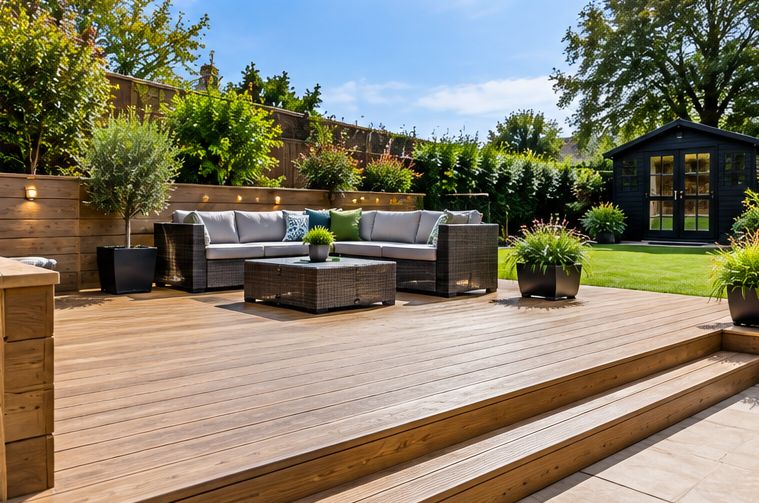
Decking has one big advantage in Tonypandy: it can create a level floor over sloping ground without shifting tonnes of soil through a narrow back lane. On a hillside terrace, where every barrow of spoil has to be wheeled out by hand, that can make it the simplest way to add usable space.
The catch is that the Rhondda is wet, and a deck in the wrong place, or built without enough air and grip, can turn green and slippery. These ideas are all aimed at small gardens, and they build on our general garden decking page and the local picture on landscaping in Tonypandy.
Idea one: a single sun deck at the top
In many Tonypandy terraces the house shades the lower part of the garden for much of the day, while the far end gets the sun. A small deck built out level at the top, where the ground rises towards the lane, turns that bright corner into the place you actually sit.
Because the deck frame stands on its own posts, it can bridge the slope rather than cut into it. Keep it just big enough for a small table and two or three chairs; any larger and it starts to dominate a narrow plot.
Idea two: two small decks and a step
On a steeper plot, one big raised deck can end up high above the neighbours’ gardens, which feels exposed and can raise privacy and planning questions. Two lower decks at different heights, joined by a wide timber step, keep each platform close to the ground and follow the natural fall.
The lower deck can sit by the back door for bins or a bistro set, and the upper one can be the quieter seating spot. Our guide to raised decking: frames, steps and balustrades explains when a handrail or balustrade is needed, and our general article on decking on a slope goes through the framing.
Idea three: a deck over tired concrete
Lots of Tonypandy back yards are covered in old concrete that is cracked but solid. If it drains and is not going to move, a low deck can sometimes be built over it on bearers, saving the work of breaking it all out. It is a quick way to change the look and feel of a yard.
There are conditions: water must be able to run off underneath, the frame must not sit in puddles, and the finished height must stay well below the damp-proof course of the house. See can you build decking over an old patio or concrete before deciding.
Idea four: built-in benches and storage
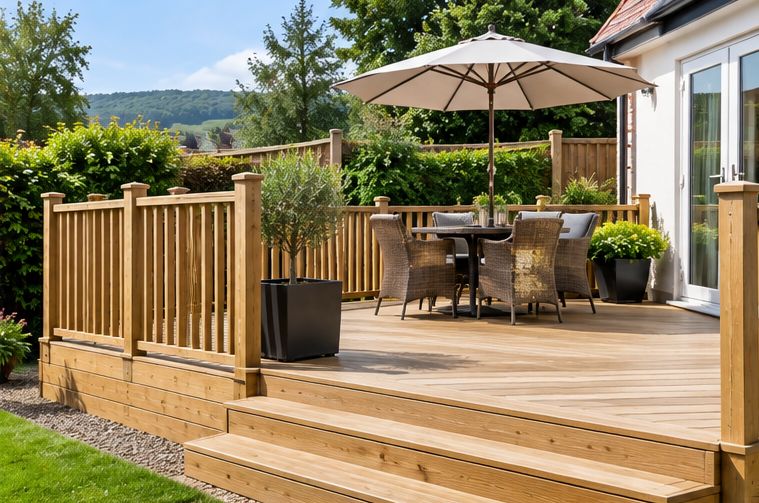
Free-standing garden furniture takes up a lot of room in a small space. A bench built along the back or side of a deck, with a hinged lid for cushions and tools, gives seating and storage in one footprint. A planter box at the end of the bench adds a bit of green without another pot to trip over.
A bin store can be built in the same boards, so the deck, seat and store read as one tidy piece. Our guide to decking lighting, planters and finishing touches has more ideas for small details.
Keeping a Rhondda deck safe underfoot
The two enemies of decking in a damp valley are standing water and shade. A deck that stays wet for days grows algae, and algae is what makes boards slippery. A few choices go a long way.
- Lay boards with a slight fall and small gaps so rain runs straight off
- Leave air space under the frame so it dries out between showers
- Choose grooved or anti-slip boards, or composite with a textured finish
- Keep overhanging shrubs trimmed back so light reaches the surface
- Give it a stiff brush and a wash in spring and autumn
Our guide to how to stop decking going slippery covers cleaning and treatments.
Timber or composite for a small deck
On a compact deck the amount of material is modest, so the choice often comes down to upkeep. Treated softwood is warm and easy to cut to odd shapes but needs regular cleaning and treatment in a wet climate. Composite boards cost more to buy but shrug off most of the weather and need far less work. Both need a sound, treated timber frame underneath.
The pros and cons are in composite or timber decking for a South Wales garden, and how long garden decking should last sets realistic expectations.
Lighting for short evenings
Tonypandy terraces lose the sun early in autumn and winter, and a deck is only useful if you can see where the edges and steps are. Low-voltage lights set into the step risers or the fascia board mark the drop clearly without lighting up the neighbours’ windows.
A single warm light on a post or on the back wall is usually enough for a small deck. Cables are easiest to run while the frame is being built, so it is worth deciding on lighting at the start rather than adding it later. Solar lights are a simple alternative, though in a shaded valley garden they may not charge well in the darker months.
Getting the boards to the garden
Decking comes in long lengths, and a narrow lane with a tight turn into the gate can make delivery awkward. We check the route on the first visit and plan cuts and deliveries so everything fits. Where there is no lane access at all, boards can come through the house with the floors protected.
Our garden decking in Tonypandy page covers our local work, and making a small Tonypandy terrace garden work harder shows how a deck fits into a wider plan. To talk through your space, ask for a free quote.
Talk to T J Landscapes about your garden
Free quotes and honest advice across South Wales.
Questions People Ask
Is decking a good idea in a wet valley like the Rhondda?
It can be, if it is built with falls, gaps, airflow underneath and a grippy surface, and kept clean. Placed in the sunniest part of a Tonypandy garden, it dries much faster than in the shade by the house.
Do I need planning permission for a small deck?
Low decks in a back garden usually do not, but a raised deck can need permission depending on its height and how much of the garden it covers. Rules can change, so check with Rhondda Cynon Taf Council if you are planning anything raised.
Will a deck overlook my neighbours?
A high deck on a sloping terrace can. Keeping it low, splitting it into two levels or adding a screen on one side usually solves that.
Decking or paving for a small sloping yard?
Decking bridges a slope with less digging; paving is harder-wearing in shade and very low maintenance. Many Tonypandy gardens end up with a bit of both. See paving a sloping Tonypandy back yard to compare.
What affects the cost of a compact deck?
The size and height, how steep the ground is, timber or composite boards, steps, balustrades, built-in seating and access through the lane. We go through each in a free quote.