
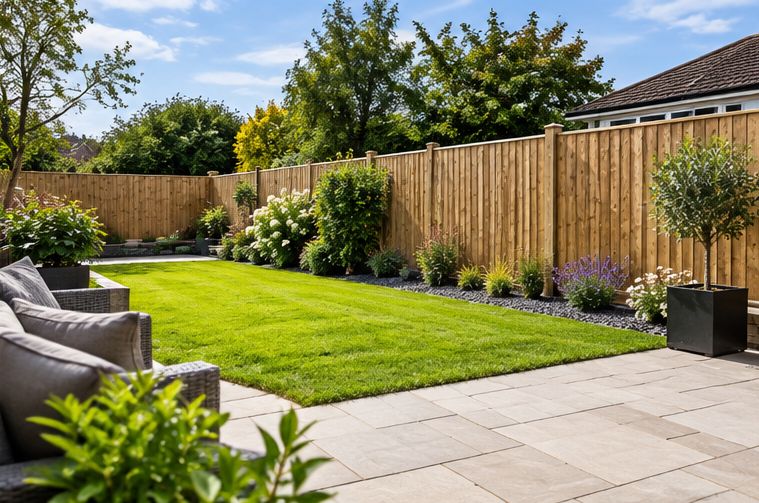
After a winter storm, a walk round Merthyr Tydfil will usually turn up a few fence panels lying flat on a lawn or leaning over a neighbour’s shed. It is not surprising. The town sits high at the top of the Taff valley, where wind is funnelled up between the hillsides and the gardens on the upper slopes catch it full on. Add soil that stays wet for months, and posts that were never set deep enough start to rock loose.
This article looks at what makes a fence strong in these conditions, which designs cope with the wind, and how to deal with the steep, stepped boundaries so common behind the town’s terraces. For a general comparison of fence styles, our guide to close board, panel or slatted fencing is a good starting point.
How wind actually brings a fence down
A solid fence panel acts like a sail. Every gust pushes on the whole face, and that force is passed down to the posts. The post works like a lever: the taller the fence, the more leverage the wind has at ground level. If the post is too short in the ground, sits in soft wet soil, or has rotted at the point where it meets the earth, it will start to move. Once it moves, the next gale finishes the job.
In Merthyr Tydfil, wet ground is the hidden part of the problem. Soil that is waterlogged for much of the winter holds a post less firmly, and timber sitting in damp earth rots faster. That is why we pay as much attention to what goes below ground as to the panels you see.
Posts: the part that matters most
For exposed Merthyr Tydfil gardens, we usually suggest one of two approaches:
- Concrete posts with concrete gravel boards. They will not rot, and panels slot into the grooves so they can flex slightly in a gust. They suit panel fencing on open, windy plots.
- Heavy pressure-treated timber posts set deep in concrete, with a gravel board so the bottom of the fence stays off the wet soil. These suit close board fencing and look more natural.
Whichever you choose, depth is critical. Posts need a good length in the ground, set in concrete shaped so water runs away from the timber rather than pooling around it. On a very exposed site we may also shorten the spacing between posts. Our guide to concrete or timber posts compares the two in more detail.
Designs that let the wind through
A fence does not have to be solid to give privacy and shelter. Designs with small gaps let some wind pass through, which reduces the load on the posts and softens gusts on the sheltered side. Good choices for Merthyr Tydfil include:
- Close board fencing, built on site with vertical feather-edge boards nailed to rails. It is stronger than most panels and easy to repair board by board.
- Hit and miss fencing, with boards fixed alternately on each side of the rails. It looks solid from most angles but lets air through.
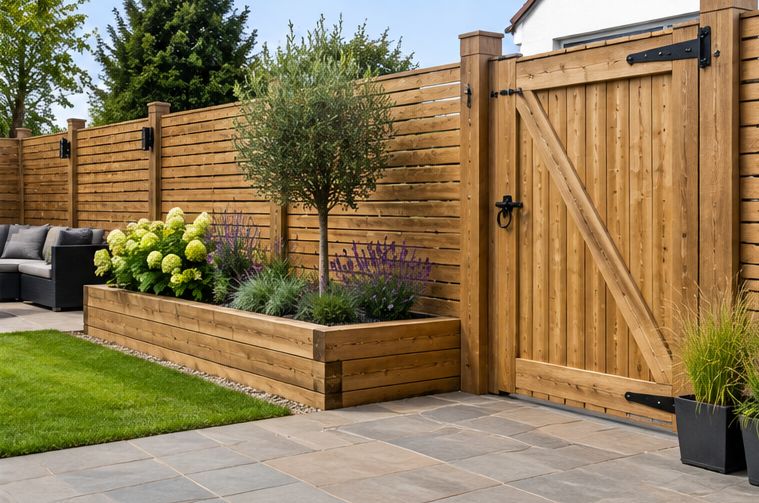
- Slatted or venetian fencing, with narrow gaps between horizontal slats. A modern look that copes well with wind.
- A lower fence topped with trellis, which gives height without a full solid face.
Lightweight, thin lap panels are the ones we see failing most often on the higher ground. They can be fine in a sheltered spot, but on an exposed boundary they rarely last. The home guide on which fence stands up to Welsh wind covers this too.
Fencing a steep Merthyr Tydfil boundary
Many back gardens in the town run up or down the hill, so the boundary fence has to follow a slope. There are two ways to do this. Stepping the fence means each panel sits level, with the step in height at every post. It suits panel fencing and looks tidy, but leaves triangular gaps at the bottom that need filling with gravel boards cut to fit or a low wall. Raking means the rails follow the slope, with vertical boards cut to the angle. Close board fencing can be raked, giving a continuous line with no gaps.
Where the ground changes level sharply at the boundary, the fence may need to sit on top of a retaining wall rather than in loose soil. That wall has to be strong enough to carry the extra wind load. Our article on retaining and boundary walls in Merthyr Tydfil explains more, and terracing a steep Merthyr Tydfil garden covers slopes in general.
Helping a fence last in the wet
Rain is almost as hard on a fence as wind. A few details make a real difference to how long it lasts here:
- Keep timber off the ground with a gravel board, so the bottom of the boards is not wicking up water.
- Fit capping rails on close board fences to stop rain soaking into the end grain at the top.
- Keep climbers, soil and piled-up leaves away from the fence face so it can dry out between showers.
- Treat or stain softwood every few years, especially on the side that gets the weather.
How to make a garden fence last longer goes into upkeep in more depth.
Neighbours, heights and practical points
Before replacing a boundary fence, it is worth talking to your neighbour, both about who owns it and about the style. Height limits apply to fences in many situations, particularly next to a road or footpath, so if you are planning anything tall, check with Merthyr Tydfil County Borough Council before work starts. We are landscapers rather than planners, so we will always suggest checking rather than guessing.
Access is the other practical point. On older terraced streets, new posts and panels may need carrying through the house or along a rear lane, and old concrete posts have to be broken out and taken away. We plan for that when we quote.
Getting it done
Tony and the team fit panel, close board, slatted and hit and miss fencing, along with gates, across Merthyr Tydfil and the valleys. You can see more on our fencing in Merthyr Tydfil page, or on the main fencing and gates page. For the rest of our local garden work, visit the Merthyr Tydfil landscaping page.
If your fence has already come down, or you want to replace it before it does, get in touch for a free quote. A photo of the boundary and the slope helps us give you useful advice straight away.
Talk to T J Landscapes about your garden
Free quotes and honest advice across South Wales.
Questions People Ask
Are concrete posts better than timber in Merthyr Tydfil?
On an exposed, wet plot, concrete posts are often the more durable choice because they do not rot. Heavy timber posts set deep in concrete also work well, especially for close board fencing, and look more natural.
Which fence copes most reliably with wind?
Close board, hit and miss and slatted designs all cope well with wind. Thin lap panels on an exposed site tend to be the first to go.
Can a new fence go on top of my garden wall?
Sometimes. It depends on the wall’s condition, height and foundations, because a fence adds a lot of wind load. We check the wall first and will say if it needs strengthening or rebuilding.
My fence posts have snapped at ground level. Can they be repaired?
If only one or two posts have gone and the panels are sound, we can often replace just those posts. If most of them are rotting, a full replacement is usually better value. See fence repair or replacement.
What affects the cost of a new fence?
The length and height, the type of fence and posts, the slope, access, and whether old fencing and concrete need removing. We set it all out in a free quote.