
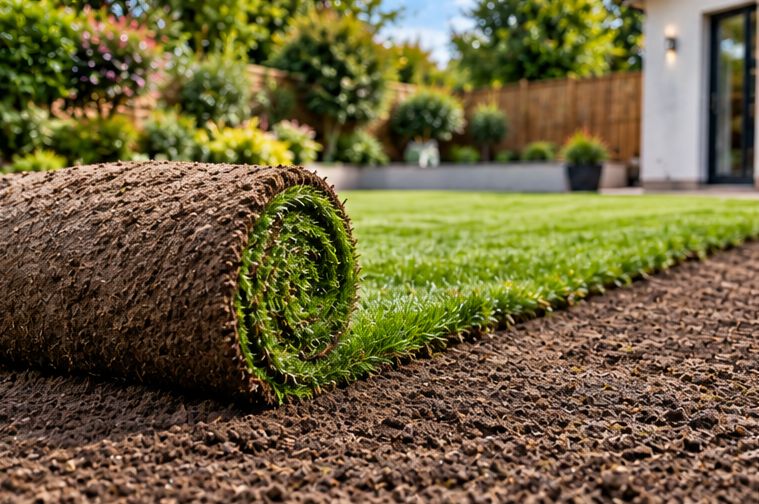
Most lawns in Pontypridd are small. On the hillside terraces there is rarely room for more than a strip of grass on one level, squeezed between a patio by the back door and a bank or wall further up. Even on the newer houses around the town, the back garden tends to be compact and often slopes.
Small does not mean simple, though. A narrow lawn has more edge for its size, it is often shaded on one side by a wall or fence, and getting a pallet of turf into it can mean a long carry. This guide covers what we look at when laying turf on a small plot in Pontypridd. For the wider picture of garden layouts in the town, see our landscaping in Pontypridd page.
Is a small lawn worth having?
It is a fair question, and we are happy to talk it through. Grass on a tiny plot still needs mowing, and if the only way to the lawn is up a flight of steps, the mower has to go up them too. Some people decide paving, gravel or a small deck suits them better.
Plenty of others want a patch of green for children, a dog, or simply something soft to look at from the kitchen. A well-laid lawn of even a few square metres does that job well. Where the garden is let to students or short-term tenants, we usually steer landlords towards easier finishes, and our guide to garden ideas for Pontypridd student lets and rentals explains why.
Where the grass goes on a sloping plot
On a hillside garden, turf is happiest on a level or gently falling tier. It can be laid on a mild slope, but a steep bank is hard to mow and dries out fast in summer. If the only space for a lawn is on the slope itself, it is usually worth creating a level for it first, with a low wall or sleepers holding the edge.
That level does not need to be perfectly flat. A slight fall away from the house and towards a border or drain helps rain run off rather than sitting on the surface, which matters in a town that sees as much rain as Pontypridd. Our guide to landscaping a hillside garden in Pontypridd covers how the tiers are planned.
Preparing the ground on a narrow strip
The ground under old terrace lawns has often been walked on for decades, used for sheds and washing lines, and topped up with whatever was to hand. It tends to be compacted, stony in places and sometimes full of old building rubble. Turf laid straight onto that will struggle.
- Strip and clear the old grass, weeds, roots and any rubble.
- Loosen the soil to break up compaction, so roots can get down and water can drain away.
- Add topsoil where the existing soil is thin or poor, and work it in.
- Rake and firm to an even surface, then rake again, so there are no soft spots or hollows.
- Check the falls so water moves off the lawn rather than pooling by the back step.
Our general guide on how to prepare the ground before laying turf goes into each step. In a small garden the whole job is quicker, but none of these stages can be skipped.
Getting the turf up the steps
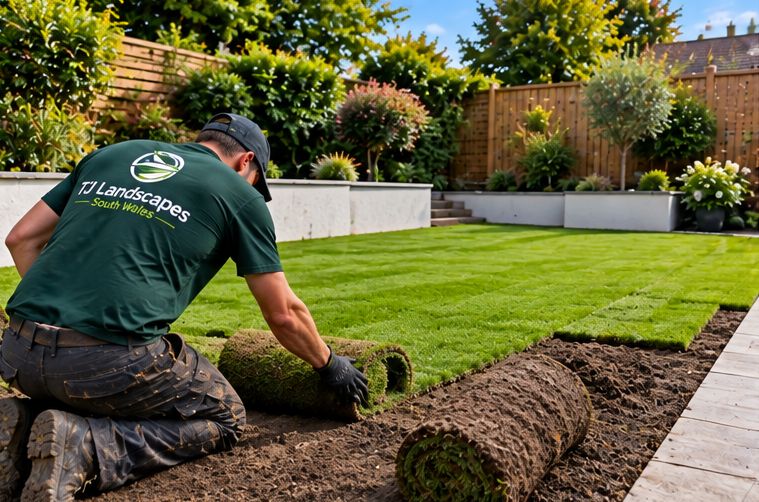
Turf is delivered on a pallet and needs laying soon after it arrives, because rolls left stacked will yellow and heat up. On a Pontypridd terrace the delivery lorry may only reach the front of the house or the lane at the back, and every roll then has to be carried through the house, along a passage or up the garden steps.
We plan for that before the day. Topsoil goes in first, often by the bag, and the turf is timed so it arrives when the ground is ready. Old soil and waste go out the same way. A bit more carrying is part of working in the town, and we build it into the quote rather than leaving it as a surprise.
Edges, shapes and easy mowing
On a small lawn the edges make a big difference to how neat it looks and how much work it is. Tight corners and fiddly curves are awkward to mow, so we usually suggest a simple shape that a mower can run along in straight passes.
A mowing strip of slabs or bricks between the grass and a wall, fence or bed lets the mower wheel run right to the edge, which saves trimming by hand. Where the lawn meets a patio, setting the turf just above the paving helps too. If a new wall or step is being built as well, we link the lawn to our brickwork and garden walls so the levels line up.
Sun and shade on the valley sides
Pontypridd sits where valleys meet, so gardens face every direction. A lawn on a south-facing slope can bake in a dry spell, while one on the shaded side of a valley, or boxed in by a high wall, may barely see direct sun in winter. Both can work, with the right turf and care.
For shaded plots we choose a turf that copes better with less light, keep the grass a little longer, and cut back overhanging branches where we can. Moss is the usual sign that shade and damp are winning, and our guide on why lawns go patchy, mossy or bare explains what to do. For a sunny plot, the main thing is watering in the first few weeks.
The first weeks after laying
New turf needs water most days in dry weather until the roots have taken, and should be kept off while it knits in. On a small lawn a watering can or a short hose run is enough. We leave clear instructions on the day, and our guide to caring for new turf in the first six weeks sets out the routine.
Spring and autumn are usually the easiest times to lay turf in Pontypridd, when the ground is moist and the weather mild, though it can be laid through much of the year if it is watered. See the turf laying page for the rest of our lawn work, our turf laying in Pontypridd page, or ask for a free quote through the enquiry form.
Talk to T J Landscapes about your garden
Free quotes and honest advice across South Wales.
Questions People Ask
Is it worth turfing a very small lawn?
If you want real grass, yes. A small lawn needs the same preparation as a large one, but the job is short and the result can make a tight Pontypridd garden feel much greener. If mowing up the steps would be a chore, we will talk through other finishes too.
Can you lay turf on a slope?
On a gentle slope, yes, and the turf can be pegged to hold it while it roots. On a steeper bank we usually suggest creating a level first, or planting the bank instead. Our guide to planting ideas for a sunny Pontypridd slope has ideas for banks.
Should I choose turf or seed for a small lawn?
Turf gives an instant lawn and is ready to use sooner, which suits a small garden that is used every day. Seed is slower and needs protecting while it grows. Our turf or seed guide compares them.
What affects the cost of turfing a small lawn?
The size, the state of the ground, how much old grass and rubble has to come out, how much topsoil is needed, any edging or mowing strip, and how far everything has to be carried. We price it after a free visit.
Will my new lawn cope with the rain in Pontypridd?
It will if the soil drains and the surface has a slight fall. Where ground stays waterlogged, we look at drainage before laying, as explained in how to stop a garden waterlogging.