
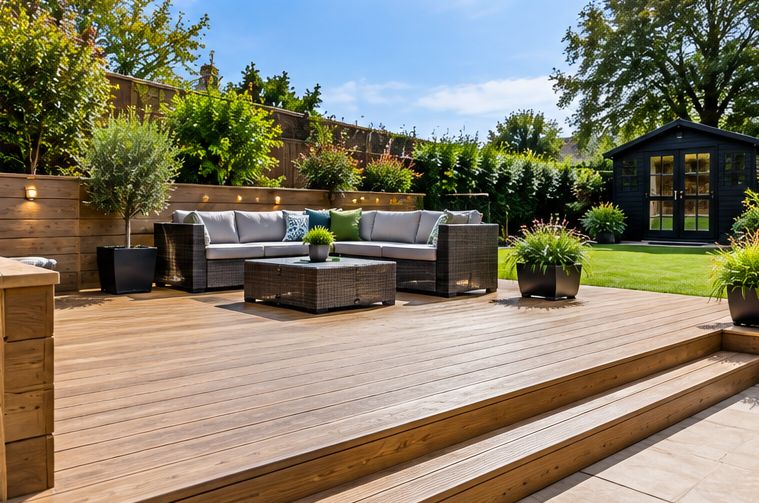
On a small town plot, decking usually goes straight off the kitchen. Out in the countryside around Talgarth the choice is wider. There might be a bank at the top of the lawn that looks straight at the Black Mountains, a corner that catches the last of the evening sun, or a spot by a pond that is too wet to pave. A deck can turn any of these into somewhere you actually use.
This guide looks at where a deck works on a rural plot, how the weather and ground shape the build, and what to think about before you ask for a quote. For the general comparison of materials, see composite or timber decking for a South Wales garden.
Choosing the spot: view, sun and shelter
Spend an evening or two walking the garden before deciding. Notice where the sun sits at the time you would be sitting out, where the wind comes from, and which views you would like to face. In Talgarth the hills are usually the draw, but a deck facing straight into the prevailing wind with no shelter will not get much use.
A good rural deck often sits a short walk from the house, with a mown or gravel path leading to it. That makes it feel like a destination rather than an extension of the kitchen. The trade-off is that you carry food and drinks further, so some people add a small store or a second, smaller deck by the house.
- Evening sun: a west-facing spot is often the most used.
- Shelter: a hedge, stone wall or slatted screen on the windward side makes a big difference.
- Trees: avoid sitting right under big trees that drip, drop leaves and keep the boards damp.
- Level: a gentle slope is easy to deck over, and far simpler than cutting a terrace for paving.
Building for mountain weather
Being at the foot of the Black Mountains means more rain, heavier dews and colder nights than a sheltered town garden. Timber that stays wet goes green and slippery, and a frame that never dries out has a shorter life. The build has to let air through and water off.
We leave a gap between boards so rain runs straight through, keep good ventilation underneath, and avoid boxing in the sides so tightly that the frame sits in damp, still air. Boards laid with a slight fall shed water more quickly. Grooved boards, anti-slip inserts or composite boards with a textured surface all help on a deck that sees little direct sun. Our guide on how to stop decking going slippery goes into the options.
Soft ground, slopes and the frame underneath
Country gardens around Talgarth range from free-draining banks to heavy, wet ground by a stream or at the bottom of a field. The frame needs firm support whatever the soil. We set posts or pads on solid footings below the soft topsoil, and on sloping ground the frame steps up on longer posts at the low end so the deck sits level.
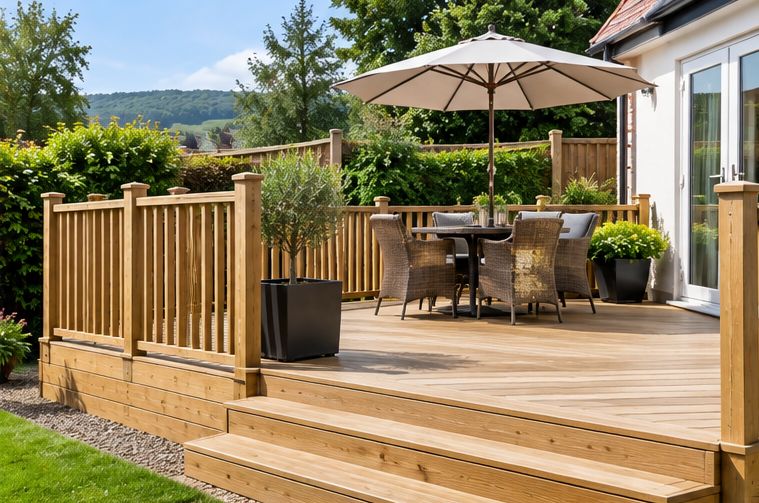
Where a deck is more than a step or two above the ground, it needs proper bracing, steps and balustrades. Raised decking: frames, steps and balustrades explained covers the structure. A membrane and gravel beneath stops weeds coming up through the gaps, which matters more in a rural garden with plenty of seed blowing in.
Timber, composite or oak for a country setting
Pressure-treated softwood is the usual starting point and weathers to a silver-grey that sits comfortably in the countryside. Hardwood and oak cost more but look right beside a stone cottage and age well. Composite boards need less upkeep and do not splinter, and many now come in muted browns and greys that suit a rural setting better than the brighter shades.
In the damp climate around Talgarth, the upkeep question is worth weighing up honestly. Timber needs cleaning and treating every so often. Composite needs a wash but not staining. Either way, how long the deck lasts depends as much on the build as on the board. Read how long should garden decking last? for what to expect.
Wildlife, livestock and the finishing touches
Rural decks have neighbours that town decks do not. A deck with open sides can become a home for hedgehogs, which many people welcome, but also for rats if food is dropped through the gaps. Fine mesh at the base, or skirting that still lets air through, keeps unwanted visitors out. If the deck sits near a field boundary, check that the fencing between the two is sound, especially where there are sheep or horses next door.
Lighting needs care too. The whole of the national park is a dark sky reserve, and bright lights spoil the night sky that many people moved here to enjoy. Low, warm, downward-facing lights on steps and edges are enough to be safe without lighting up the hillside. Decking lighting, planters and finishing touches has more ideas.
Permission, access and getting a quote
Low decks are usually straightforward, but raised decks above a certain height, decks near a boundary and work at listed buildings can need planning permission. Much of the land around Talgarth falls within the Brecon Beacons National Park Authority's area, so if the deck will be raised or the house is listed, check with them first.
For the quote, we look at the size, the height, the ground, the materials you prefer and how far everything has to be carried from where a delivery can be dropped. On rural plots, access through gateways and across lawns can make a real difference to how the job is planned. If the deck is part of a bigger scheme, our guide to country garden design ideas for Talgarth homes may help you think about the whole garden.
See our garden decking page for the kinds of decks we build, and our landscaping in Talgarth page for the wider picture.
Talk to T J Landscapes about your garden
Free quotes and honest advice across South Wales.
Questions People Ask
Can you build a deck at the far end of a big garden?
Yes. Materials can be carried or barrowed across, and we plan deliveries so they land as close as possible. A path to the deck, in gravel, stepping stones or mown grass, finishes it off.
Will a timber deck cope with the rain near the Black Mountains?
It will if it is built to shed water and dry out: gaps between boards, a slight fall, air under the frame and boards with grip. Regular cleaning keeps algae down.
Is composite decking a good choice for a country cottage?
It can be. Muted, wood-like colours blend in well and the upkeep is low. Some people still prefer the look of real timber or oak beside old stone, so it is worth seeing samples.
Can a deck go over soft or boggy ground?
Often it is one of the better options for damp spots, because the frame sits on footings dug down to firmer ground. Very wet areas may need drainage first, which we can look at during the visit.
How do I get a price?
Get in touch with a few photos of the spot you have in mind. Tony will visit, look at the ground and access, and give you a free quote.