
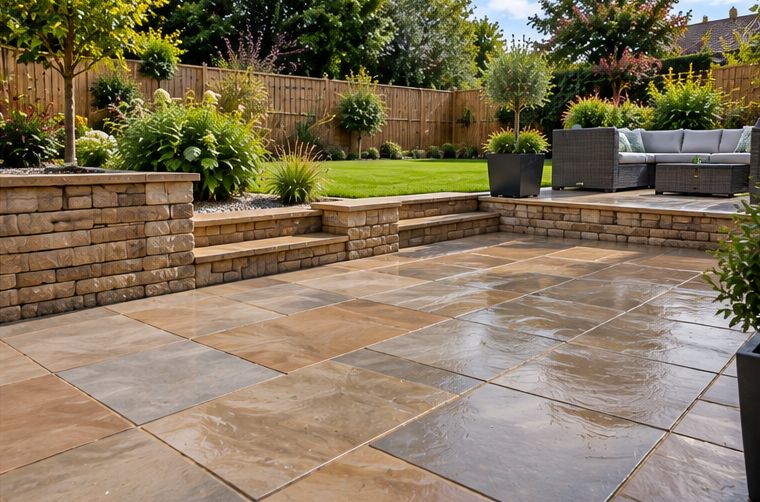
Ebbw Vale grew as a steel town, and rows of terraced houses were built along the valley sides for the families who worked there. Many of those homes still have the same kind of back garden: a narrow strip, often climbing or dropping away from the house, with an old yard, a few steps and a wall at the top or bottom.
Those gardens can make lovely outdoor spaces, but a patio that would suit a flat suburban plot rarely works as it stands. Here are the ideas we come back to most often when paving an Ebbw Vale terrace garden, and the practical points that decide whether they will last.
Work with the slope, not against it
The biggest decision in most terrace gardens is how to handle the change in level. Trying to flatten the whole plot usually means a very tall retaining wall and a lot of spoil to shift. Splitting the garden into two or three smaller levels is almost always easier, safer and better looking.
A common layout is a paved area by the back door for bins, washing and a small table, a few steps up or down, then a second terrace further out that catches more sun. Each level can be paved, gravelled, planted or turfed. There is more on how to plan the levels in making a sloping Ebbw Vale garden usable, and on the walls that hold them in retaining walls for Ebbw Vale hillside gardens.
Chase the sun and the shelter
In a terrace, the house, the next row up the hill and the neighbours' extensions all cast shade. The spot right outside the back door is not always the sunniest. It is worth watching the garden through a day and putting the seating where the light lands in the late afternoon, even if that is at the far end.
At this height, shelter matters as much as sun. The top of a terrace garden can be surprisingly exposed, so a low wall with a built-in bench, a screen of planting or a slatted fence panel beside the seat can make the difference between a patio you use and one you look at through the window.
Pick a surface for a wet, frosty town
The paving in an Ebbw Vale garden spends a lot of its life wet, and in winter it freezes. Grip and resistance to frost come first; colour and style come after.
- Porcelain absorbs very little water, so it resists moss and frost well. Choose a textured, outdoor-rated slab rather than a smooth one.
- Indian sandstone has a naturally riven, grippy surface and warm colours that suit old stone and brick terraces, though it needs sealing or regular cleaning in damp shade.
- Granite is very hard-wearing and usually comes with a textured finish that suits steps and paths.
- Concrete flags in a textured finish are a practical choice for a utility area by the back door.
We compare these in more depth in porcelain, sandstone or concrete. Whatever you choose, a proper build and a steady fall away from the house matter more than the slab itself, as explained in how a patio should be laid.
Plan where the rainwater goes
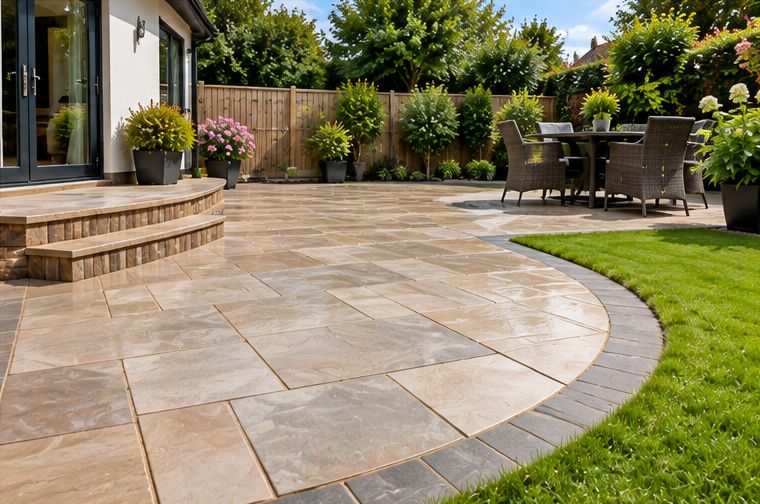
On a sloping terrace plot, water arrives from above as well as falling from the sky. A patio at the bottom of the garden, or one set right up against the back wall of the house, needs somewhere for that water to go. That might be a fall towards a gravel strip or border, or a channel drain at the foot of the steps linked to a suitable drain.
Paving should also sit below the damp-proof course of the house. On old terraces the level can be tight, so we check it carefully before anything is dug. If your garden is wet in general, read drainage for wet gardens in Ebbw Vale before planning the patio.
Small-space ideas that earn their keep
In a narrow plot, every feature should do more than one job. These are the extras that tend to work well in Ebbw Vale terrace gardens.
- Built-in seating along a retaining wall, which saves space and gives the wall a purpose.
- Raised beds in brick or sleepers along one side, so planting sits above the wet ground and at a comfortable height.
- A paved path laid in the same stone as the patio, so the garden reads as one space rather than a string of pieces.
- A tidy, screened spot for bins near the rear gate or lane.
- Low-voltage lighting on steps and the patio edge for dark winter evenings.
- Planting pockets or pots to soften all that hard surface.
Getting materials in and waste out
Access is often the hidden challenge with a terraced house. If there is a rear lane with a gate, materials can come in that way. If not, slabs, sand, cement and the old concrete coming out all have to be carried through the house or along a shared path. That adds time, so it is one of the things that affects the price.
We protect floors and doorways when we have to work through a house, plan deliveries so the lane or street is not blocked for long, and take all the waste away with us. If the garden needs clearing first, that can be part of the same job.
Talk it through with us
Every terrace garden is a little different, so the best place to start is a visit. Tony and the team can look at the levels, the drainage and the access, and give you free advice and a free quote. See the materials and finishes we lay on our patio slabbing and paving page, read more about our work in the town on our Ebbw Vale landscaping page, or send us a message to arrange a visit.
Talk to T J Landscapes about your garden
Free quotes and honest advice across South Wales.
Questions People Ask
Can you lay a patio in a very narrow Ebbw Vale terrace garden?
Yes. Narrow gardens often suit a simple design with one or two levels, a path and some planting. The width mainly affects how we get materials in and how the space is laid out, not whether a patio is possible.
Which slabs are safest on wet, sloping ground?
Anything with a textured or riven surface. Outdoor porcelain with a grip finish, riven sandstone and textured granite all keep their grip well in the wet. We avoid smooth, polished surfaces for steps and shady spots.
Do I need a wall to make a level patio on a slope?
Usually some kind of retaining edge is needed, whether that is a brick or block wall, stone or sleepers. Splitting the garden into smaller levels keeps each wall lower and simpler. Taller retaining walls may need engineering advice.
We have no rear access. Can you still do the job?
Yes. Everything can be carried through the house if needed. We protect the route and plan the work so it causes as little disruption as possible, and it is one of the things we factor into your free quote.
Can you reuse the old stone in our yard?
Often, yes. Old flags, stone or bricks from the garden can sometimes be cleaned and reused as edging, steps or part of the new patio, which keeps some character and cuts down on waste.