

A good wall gives a Port Talbot garden something a fence cannot: weight, permanence and a solid edge that will not rattle loose in a gale. It can shelter a seating area, tidy up a front garden, hold back a slope or frame a set of raised beds. Built badly, though, a wall on the coast can crack, crumble at the joints or stain white with salt within a few winters.
Below we go through what makes a wall last here, from the way it handles the wind to the ground it stands on. For the full range of walls, piers, steps and planters we build, see our brickwork and garden walls page, or the local page for brickwork in Port Talbot.
Shelter without the eddies
It seems natural to build a tall solid wall on the windy side of the garden, and a wall does cut the wind right behind it. The catch is what happens a little further in. Air that is forced up and over a solid barrier tumbles down on the far side as gusts and swirls, so a patio a few metres from the wall can end up feeling no calmer than before.
There are a few ways around this that we often use in exposed parts of Port Talbot:
- A low wall topped with trellis or slats, which gives a solid base and lets the upper part filter the wind.
- Pierced or honeycomb brickwork, with gaps left in the bond so some air passes through.
- A wall with planting behind it, where a salt-tolerant hedge takes over from the top of the brickwork. Our guide to planting for wind and salt in Port Talbot lists shrubs that suit.
- Short returns or L-shapes around a seating area, which make a sheltered pocket without building a long high run.
What salt air does to brick and mortar
Salt carried in on the wind soaks into brick and mortar with the rain. As the wall dries, the salt crystallises near the surface. The white bloom that follows, called efflorescence, is mostly cosmetic and tends to fade, but repeated wetting, drying and freezing can slowly break down soft bricks and weak joints.
The answer is a wall that keeps as much water out as possible and uses materials that can take it:
- Frost-resistant facing bricks rated for exposed positions, rather than soft or second-hand ones of unknown quality.
- A mortar mix suited to an exposed garden wall, with joints finished so they shed water.
- A proper coping with an overhang and a drip, so rain runs clear of the face instead of down it.
- A damp-proof course near the base, so moisture from the ground does not wick up the wall.
Our guide to choosing bricks and coping goes into these choices in more detail.
Footings on sandy and made ground
What sits under the wall matters as much as the wall itself. Close to Aberavon the ground is often sandy. Sand is firm when it is confined, but it can move if it is loose near the surface or if water washes through it. On some of the estates and older plots, the top layer may also be made ground: soil and rubble left from building work, which can settle unevenly.
In either case we dig down to firm, consistent ground and pour a concrete footing sized for the height and length of the wall. It is the least glamorous part of the job and the part you never see again, but it is the part that decides whether the wall stays straight. There is more on this in our article on garden wall foundations.
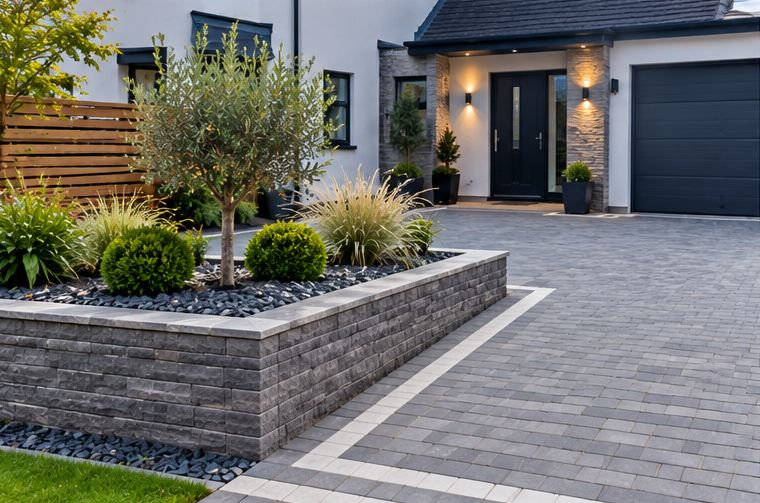
Front walls for terraces and estate houses
Many Port Talbot homes are terraces or post-war semis, and a front wall is often the first thing people notice about them. On a terrace, a low brick wall with a neat coping that matches the neighbours keeps the street looking tidy. On a post-war estate, where houses are often rendered or part-rendered, a rendered block wall with a brick or stone coping can look cleaner than bare brick.
Think about how the front garden is used before settling on the layout. Bins need a route out, a gate needs piers strong enough to hang from, and if you might want to park off the road one day it is worth planning an opening now. Our guide to patio paving for Port Talbot semis and terraces covers the paving side, which we can do at the same time. Our landscaping in Port Talbot page shows how walls fit with the rest of a coastal garden.
Walls that hold back a slope
Port Talbot is not all flat seafront. The town climbs up the hillsides inland, and on those streets a garden wall often has to hold soil as well as mark a boundary. A retaining wall is a different job: it needs drainage behind it so water does not build up, a stronger build and, above a modest height, a design from a structural engineer.
If your garden steps up the hill, a series of lower walls with level beds or terraces between them is often easier and safer than one tall wall. See when a retaining wall needs engineering advice before planning anything substantial.
Raised beds and planters in brick
Brick raised beds are one of the most useful things to build in a coastal garden. They lift plants out of poor sandy soil, give you a proper depth of good topsoil, double as seating along a patio and add a sheltering edge to a seating area. The same care over bricks, coping and drainage applies. Our guide to building brick raised beds and planters explains how they are put together.
Heights, boundaries and the council
As a general guide, garden walls up to about one metre next to a road and about two metres elsewhere often do not need planning permission, but that is not the case everywhere, and listed buildings, conservation areas and some estates have their own rules. Check with Neath Port Talbot Council if in doubt.
If the wall will sit on or near the boundary, speak to your neighbour first. Shared walls can bring in party wall rules, and it is wise to get proper advice on those. We are wall builders rather than solicitors, but we are happy to talk the plan through with both households.
Talk to T J Landscapes about your garden
Free quotes and honest advice across South Wales.
Questions People Ask
Why has my garden wall gone white?
That white bloom is usually efflorescence: salts carried to the surface as the wall dries. It is common on new walls and near the coast, and it usually fades with time. If the bricks are also flaking, the wall may be staying too wet, and the coping and joints are worth checking.
Is a wall better than a fence in a windy Port Talbot garden?
A wall will not blow over or rattle loose, but a solid one causes gusts on the sheltered side. A low wall with trellis or slats on top often gives the best of both.
Can you repair an old wall rather than rebuild it?
Often, yes. Loose copings, crumbling joints and the odd damaged brick can be put right. If the wall is leaning because the footing has failed, rebuilding is usually the lasting fix.
What decides the cost of a garden wall?
Length, height, the bricks or blocks chosen, the depth of footing needed, access to the garden and how much old wall or soil has to go. We set it all out in a free quote.