
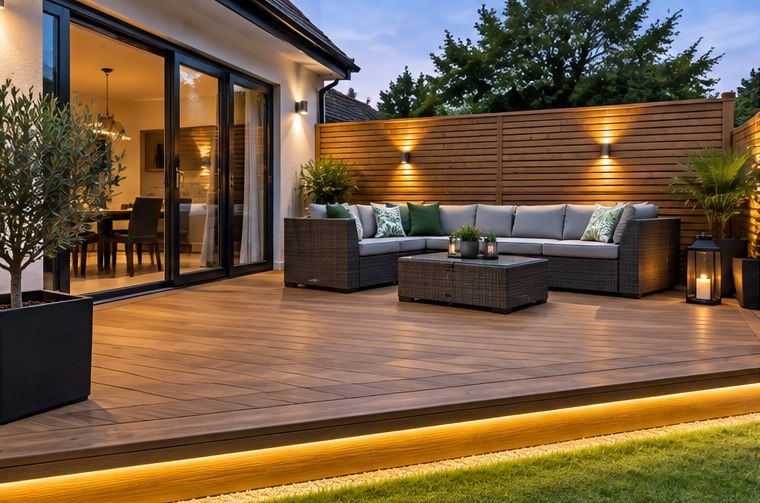
Decking is popular in Aberdare for a simple reason: many gardens here slope, and a deck can create a level place to sit without the digging and retaining walls a patio would need. Built well, it gives you a dry, flat platform just outside the back door, often with a view across the valley.
The big question is usually whether to go for timber or composite boards. This guide answers it for Cynon Valley conditions. The general comparison is in composite or timber decking for a South Wales garden; for what we build, see our garden decking page, and for the town, landscaping in Aberdare.
What an Aberdare deck has to cope with
Three things shape the choice here. The first is rain: the valley is wet for much of the year, so boards spend long spells damp. The second is shade: a deck behind a terrace, under trees or on the side of the valley that loses the sun early may rarely dry out properly. The third is slope, which affects how high the deck sits and how much of the frame is exposed.
A sunny, open deck on a newer estate plot faces a different life from a shaded one tucked behind a Victorian terrace, and the right board may differ too.
Timber decking: the case for it
Pressure-treated softwood is the traditional choice. It looks and feels natural, it can be cut and shaped on site to fit awkward corners, and it is usually the lower-cost option to buy. Grooved boards give some grip, and the colour can be refreshed or changed with a stain.
The trade-off is upkeep. In a damp, shaded Aberdare garden, timber needs regular cleaning to keep algae down and a fresh coat of treatment every year or two to stay in good condition. Looked after, it lasts well; left alone, it can turn green and slippery. See how long should garden decking last.
Composite decking: what changes
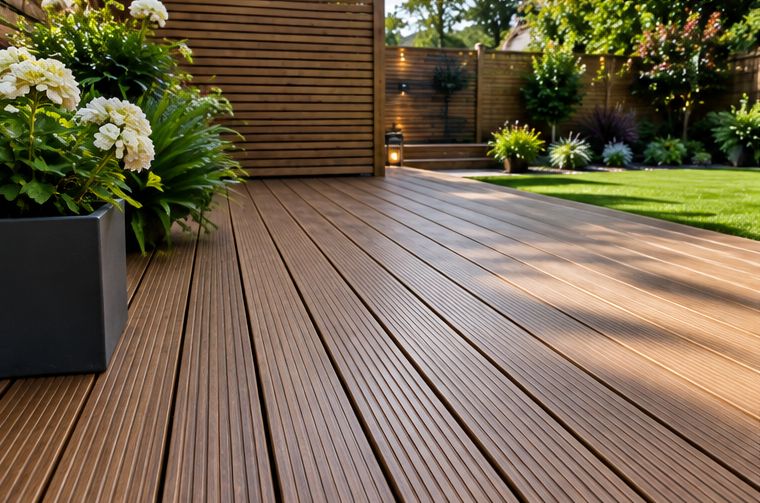
Composite boards are made from a mix of wood fibre and plastic, usually with a protective outer layer. They do not need staining or oiling, they resist rot and splinters, and the colour stays fairly even for years. Most good-quality boards have a textured surface that grips well when wet.
Composite costs more to buy than treated timber and can get warm in strong sun, though that is rarely a problem in a Cynon Valley garden. It still needs an occasional wash to clear dirt and leaf litter, and it still sits on a frame, usually timber, that has to be built properly.
Grip on wet days
Whichever board you choose, a deck in Aberdare will often be wet. A slippery deck is a common complaint about old decking, and it is often down to algae on shaded timber that has not been cleaned.
- Choose grooved or textured boards rather than smooth ones.
- Keep the deck clear of leaves and give it a brush every few weeks in autumn and winter.
- Let air and light reach it: trim back overhanging branches where you can.
- On a shaded spot, composite usually needs less effort to keep safe underfoot.
There is more in how to stop decking going slippery.
The frame matters more than the boards
Most decks that fail early do so because of the frame, not the boards. On damp ground the joists need to be treated for ground contact, kept off the soil and supported on posts or pads set on a firm base. A weed membrane and a layer of gravel under the deck stop growth and help water drain away.
Air must be able to move under the deck so the timber can dry between showers. Where a deck sits against the house, it must stay below the damp proof course and leave a gap so water does not track into the wall. On a sloping Aberdare plot the frame may need to be raised at the far end, which brings steps and, on higher decks, balustrades into play; see raised decking: frames, steps and balustrades.
Where to put the deck, and how big
Before choosing boards, decide where the deck goes. Right outside the back door is the obvious spot and the most used, but it is not always the sunniest. In some Aberdare gardens the best light is at the top of the slope, and a small deck up there, reached by steps, gets far more use on summer evenings than one in the shadow of the house.
Size it for what you will actually do on it. A table for four and room to pull the chairs out needs more space than most people expect, while a bench and a couple of pots need very little. A raised deck on a valley side can also look straight into the neighbours' gardens, so think about privacy screens or planting along the edge at the same time.
Which to choose for your garden
As a rough guide, timber suits a sunny, open garden where you are happy to do some upkeep and want a natural look. Composite suits a shaded or damp spot, a family deck that gets a lot of use, or anyone who would rather wash a deck than treat it.
Decking is not the only way to level a slope. Some Aberdare homeowners are better served by a patio on a retaining wall, especially close to the house; see terraced garden design in the Cynon Valley and patio slabbing for Aberdare terraced houses. You can also read about our garden decking in Aberdare, or ask for a free quote and we will talk through both options on site.
Talk to T J Landscapes about your garden
Free quotes and honest advice across South Wales.
Questions People Ask
Does decking rot quickly in the valleys?
Not if it is built properly. Rot usually starts where timber sits on wet soil or where water cannot drain away. Ground-contact joists, a gravel base, good airflow and regular care make the difference.
Can you build decking over my old patio or concrete yard?
Often, yes, as long as the surface drains and the finished height works against the house. See can you build decking over an old patio or concrete.
Can you add lights and planters to a deck?
Yes. Low-level lights in steps and edges make a deck safer on dark evenings, and built-in planters soften it. Our guide to decking lighting, planters and finishing touches has ideas.
Is decking or paving better on a slope?
Decking usually needs less digging on a slope, because the frame takes up the difference in level. Paving needs the ground cut and filled and often a retaining wall, but it lasts longer with less upkeep. On many Aberdare plots the answer is a patio by the house and a deck further up the garden.
What affects the cost of a deck in Aberdare?
The size, the height of the frame on a slope, the board type, any steps or balustrades, the ground conditions and access. We explain each one in a free quote.