
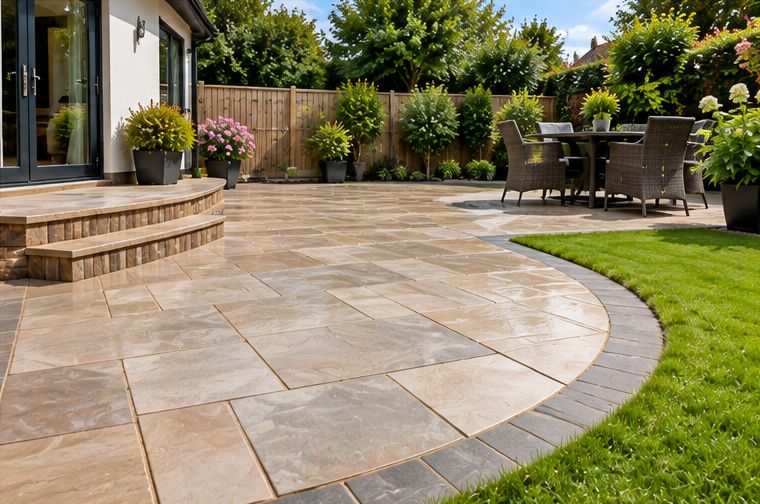
Away from the seafront, a large share of Port Talbot's housing is terraced streets and the post-war estates that grew up with the town. The back gardens are rarely huge. Many terraces have a narrow yard with a wall on each side, and a lot of semis have a strip of tired lawn, an old concrete path and a shed at the far end. In both cases a patio is often the single change that makes the garden feel usable.
This guide looks at patios for those two types of home in Port Talbot: the layouts that work, the slabs that cope with the coastal weather and the practical side of getting the job done. For how a patio should be built underneath, see how a patio should be laid, and our patio and paving page shows the full range.
The narrow terrace yard
In a terraced yard, space is tight and every centimetre counts. Paving the whole yard from wall to wall is often the most practical choice, giving a clean, dry surface for bins, a table and a few pots. Larger slabs laid in a simple pattern make a small area look bigger than lots of small units, which can look busy.
Terrace yards often have a mix of old surfaces: cracked concrete, a raised step by the back door, a drain gully in the corner and perhaps an outside toilet or store. We lift what needs lifting, keep the levels below the damp-proof course of the house and make sure water runs to the existing drain rather than towards the back door.
Walls on both sides also mean shade for part of the day. Paler slabs brighten a shaded yard and show less of the salty film that settles after a windy spell, while very dark stone can look gloomy in a narrow space. If the yard gets sun at the far end, that is often the place for the table, with the paving leading you towards it.
The post-war semi garden
Semis on Port Talbot's estates usually have longer, wider gardens, which gives more choice. A common plan is a patio near the house, sized for a table and chairs, with a lawn beyond and a path running to a shed or gate. Setting the patio a step or two away from the back door, or wrapping it round a sunny corner, can catch more light than a strip hard against the wall.
On the more exposed estates, think about shelter at the same time as paving. A patio with a slatted screen or a low wall on its windward side is a far more pleasant place to sit. Our coastal garden ideas for Port Talbot homes cover shelter in more depth.
Slabs for sea air and blown sand
Near the coast, salt spray and fine sand settle on paving, so dense, low-porosity materials make life easier. Some reliable choices for Port Talbot gardens:
- Porcelain paving: very dense, stain-resistant and quick to hose down, which suits a small yard well.
- Indian sandstone: warm colours and a natural riven texture, best sealed to help it resist marking.
- Granite paving: hard-wearing and grippy, a good option for a busy family semi.
- Block paving: ideal for paths and off-road parking, with joints kept topped up with sand.
Whatever you choose, the joints matter. Open or poorly filled joints soon collect blown sand, then seeds, then weeds. We use a jointing method that suits the stone and fills fully to the surface. Our article comparing porcelain, sandstone and concrete slabs has more on the differences.
Getting materials in
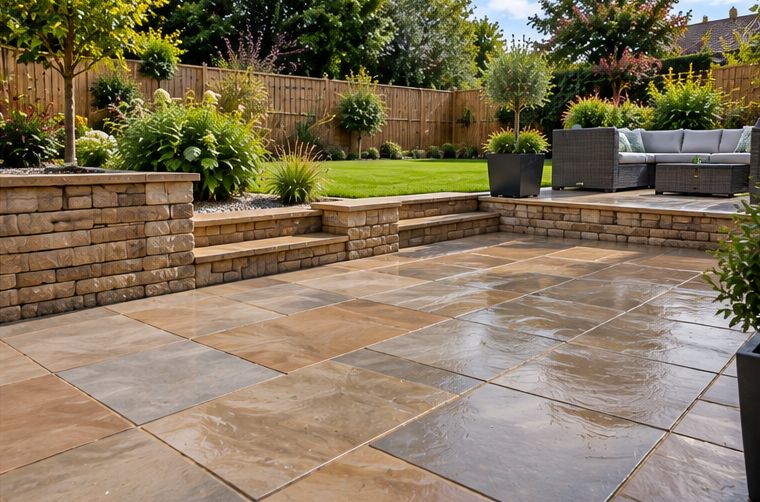
Access shapes a lot of patio work in Port Talbot. Some terraces have a rear lane, which makes it straightforward to bring in slabs, sand and cement and to take away the spoil. Mid-terrace houses without a lane mean everything comes through the house, so we protect floors, plan deliveries carefully and move materials in manageable loads.
Semis usually have side access, but a narrow path or a gate between the house and a neighbouring fence can still slow things down. We check access on our first visit, because it affects how long the job takes and the work involved.
Where old concrete has to be broken out, the waste can add up quickly, and it all needs taking away. On bigger clear-outs we sometimes combine the patio with a wider tidy-up, clearing old sheds and overgrowth at the same time so the garden starts afresh.
Falls and drainage in a small space
Every patio needs a gentle fall so rain runs off rather than sitting in puddles. In a narrow yard enclosed by walls, there is often only one sensible direction for the water to go, and it has to reach a drain or a soakaway. Where there is nowhere obvious, a channel drain along the edge of the paving may be needed.
Sandy ground nearer the beach usually drains freely, which helps, while heavier soil further inland can hold water. We look at the ground under your Port Talbot garden before deciding on the sub-base and drainage. Our guide to why patios sink, crack or lift explains what goes wrong when this is skipped.
Adding the finishing touches
A patio is often the start of a wider tidy-up. Brick or sleeper raised beds along the edge of a terrace yard give you planting without losing paving, and a low wall can double as extra seating. On semis, a decked area or a new lawn beyond the patio can complete the garden. See decking in a salty Port Talbot garden and low-maintenance gardens for Port Talbot homes for ideas.
Keeping a new patio looking its best is mostly a matter of sweeping, the odd wash and checking the joints. Our guide on how to look after a new patio has the details, and our patio paving in Port Talbot page shows what we lay locally.
Talk to T J Landscapes about your garden
Free quotes and honest advice across South Wales.
Questions People Ask
Can you pave a terraced yard with no rear access?
Yes. Everything comes through the house, so we protect the floors and plan the work in stages. It takes more care but is a very common job on terraced streets.
What paving is easiest to keep clean near the sea?
Porcelain is the easiest to rinse and resists staining well. Sealed sandstone and granite also cope well with salt air. Well-filled joints stop blown sand and weeds taking hold.
Should I pave over my whole back garden?
In a small terrace yard, often yes. In a larger semi garden, a patio with a lawn or planting beyond usually drains better and feels more pleasant. We can talk through both on a visit.
What affects the cost of a patio in Port Talbot?
Size, the slabs you choose, access for materials, how much old concrete needs breaking out and removing, and any drainage work. A free quote covers it for your garden.
Do you work in every part of Port Talbot?
Yes. See our Port Talbot landscaping page for more, or ask for a free quote and we will arrange a visit.