
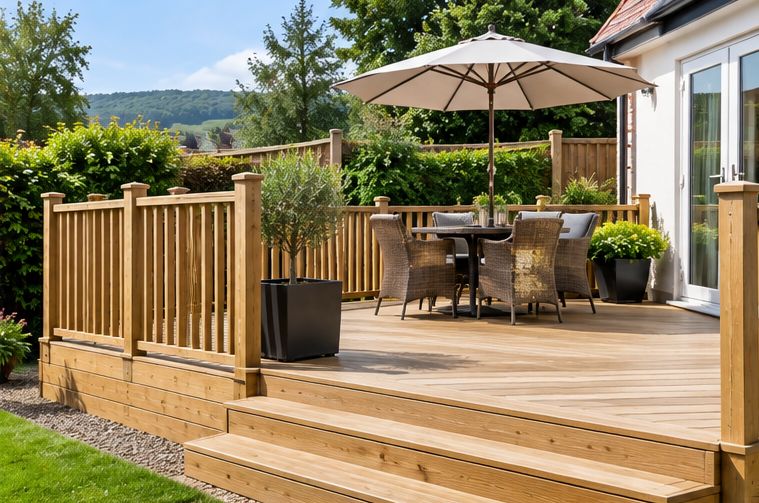
Timber feels at home in Monmouth. Oak frames, old barns and wooded hills are part of the look of the town and the country around it, so it is no surprise that many people here ask us about an oak deck rather than the usual softwood boards. Both can work well. They just behave very differently once they are down and the weather gets at them.
This guide looks at the choice from a Monmouth point of view: period houses in the centre, damp ground near the Wye and the Monnow, and larger gardens outside town where a deck might sit a long way from the house. For the general case for and against composite, see our guide to composite or timber decking. For what we build, see our garden decking page.
Two very different timbers
Softwood decking is almost always pine or spruce that has been pressure-treated against rot and insects. It is light, straight, easy to cut and quick to fit, which is why it covers most decks you see. It usually starts a green or honey colour and fades over the first year or so.
Oak is a dense native hardwood. It is heavier, harder to work and slower to fit, and it needs different fixings. In return it has real presence: the grain is richer, the boards feel solid underfoot, and it weathers to a soft silver-grey that sits comfortably beside stone. Oak is sold either green (freshly sawn and still wet) or air or kiln dried, and that matters a great deal for decking, as we explain below.
What suits the older houses in Monmouth
Behind the period town houses in Monmouth, a deck is usually small: a platform outside the back door, a seat in the sunniest corner or a step down from a raised kitchen. In a walled garden of old stone or brick, bright new softwood can look out of place for its first season, while oak tends to settle into its setting within a year or two.
That said, a well-chosen softwood deck with a muted stain can look just as good, and it is far easier to carry through a narrow side passage or through the house. Where access is tight, weight and board length are real considerations. Oak boards are heavy, and long lengths can be awkward to get round corners.
If your home is listed or sits in a conservation area, it is worth checking with Monmouthshire County Council before building anything raised or close to the house. We can help with the practical side, but we are landscapers, not planners.
Damp ground near the rivers
Lower parts of Monmouth, and plenty of gardens around it, can stay wet through the winter. A deck is often a good answer here because it lifts the seating area above soft ground. But the timber closest to the soil works hardest, so the frame matters more than the boards.
- Joists and posts should be treated for ground contact, even when the top is oak.
- Posts do far better on concrete pads or adjustable supports than buried in wet soil.
- Leave a generous gap beneath for air to move, and keep the sides open where you can.
- Put down a membrane and gravel so the ground under the deck drains and stays clear of weeds.
- Where water sits for days, fix the drainage first. Our guide to gardens near the Wye and Monnow covers the options.
An oak top on a softwood frame is a common and sensible build. The oak gives the look and the wear, and the treated joists give reliable support, provided they are kept dry and ventilated.
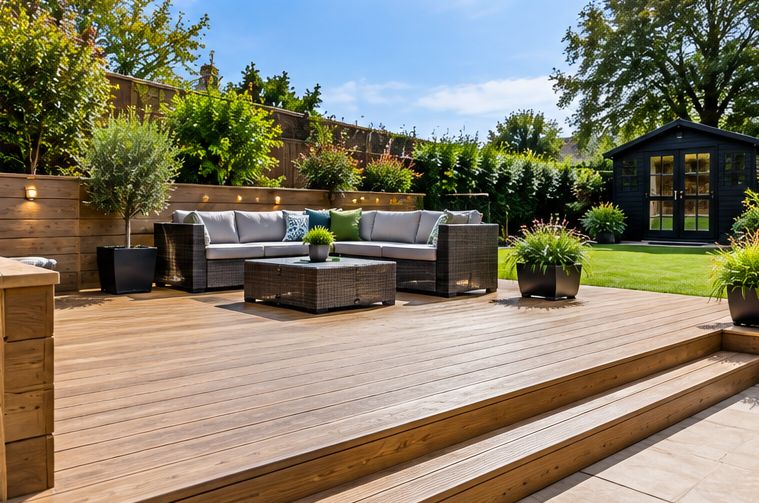
Getting oak right: movement, tannin and fixings
Oak is not a drop-in swap for softwood. It moves as it dries, so green oak laid tight can open up wide gaps, twist or cup over its first summer. Dried oak is more stable and is usually the better choice for decking boards, though it still needs sensible gaps between boards.
Oak is also rich in tannin. When it first gets wet, it can bleed a dark stain onto paving or gravel below, and it reacts with ordinary steel to leave black marks around screws. We use stainless steel fixings with oak, pre-drill the holes and think about where the run-off will go, especially if the deck steps down onto a new patio.
Small surface cracks, called checks, are normal in oak and are not a fault. They tend to close up again in wetter weather.
Softwood: the practical choice for bigger decks
On a larger rural plot outside Monmouth, a deck might be a big terrace off the back of a farmhouse or a platform down by a pond. At that scale, treated softwood is often the practical answer. It is lighter to move across a long garden, quicker to build and much easier to repair, since a damaged board can be swapped in minutes.
Good softwood needs a bit of care. Seal any cut ends, clean it once or twice a year and add oil or stain when it starts to look dry. Grooved boards can hold water and algae in shady spots, so smooth boards are sometimes the better option under trees. Our guide on how to stop decking going slippery has more on grip in damp gardens.
How each one ages
Left alone, both timbers go grey. Oak does it gracefully and keeps its strength, and many owners are happy to let it silver naturally with just a yearly scrub. Softwood also silvers, but it is more likely to show raised grain and small splits if it is never treated.
How long either lasts depends on shade, airflow and how the frame was built as much as the timber itself. Our guide to how long garden decking should last goes into this in more detail.
Choosing for your garden
As a rough guide, oak makes most sense for a smaller, sunny deck close to a period house, where the look matters and you want it to weather naturally. Softwood makes most sense for larger areas, tight access, shaded corners and tighter budgets. On a sloping plot, either can be built as a raised deck; see raised decking frames, steps and balustrades.
Tony and the team will look at the site, the light and the ground, bring samples if you would like to compare them, and give you a free quote. Read more about our work across the town on our Monmouth landscaping page, or get in touch to arrange a visit.
Talk to T J Landscapes about your garden
Free quotes and honest advice across South Wales.
Questions People Ask
Will an oak deck stain my patio?
It can when it is new. Oak releases tannin when it first gets wet, which can mark pale paving or gravel. Planning where the water drips, and letting the oak weather for a while, usually deals with it. Stainless fixings avoid black marks around the screws.
Is oak decking slippery?
Any timber can get slippery when it is damp and green. Oak is dense and does not hold water as readily as softwood, but in a shaded Monmouth garden it still needs regular sweeping and cleaning to keep algae off.
Can you mix oak and softwood in one deck?
Yes. A treated softwood frame with oak boards on top is a common build, and oak is also popular for steps, edging or a handrail on a softwood deck.
What affects the cost of an oak or softwood deck?
The size of the deck, the timber, the height and complexity of the frame, access to the garden, ground conditions and any drainage or levelling work. Oak is dearer to buy and slower to fit. We explain it all in a free quote.
Do I need permission for a raised deck?
Sometimes. Decks well above ground level, large decks or those that overlook neighbours may need planning permission, and listed homes have their own rules. Check with Monmouthshire County Council before you build.