
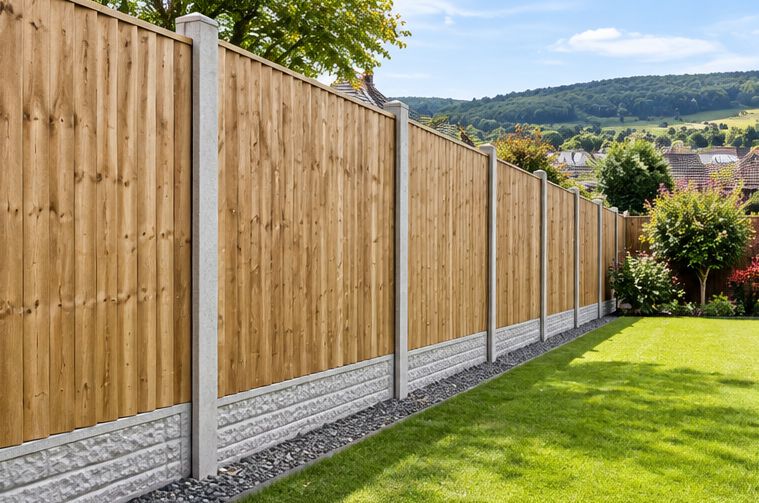
Garden boundaries in Aberbeeg tend to climb. They run up the side of a sloping plot, along the top of a bank or between neighbouring yards that sit at different heights. Add soil that stays wet for much of the year and a lot of shade, and it is easy to see why fences in the village can lean, rot or sag sooner than they should.
This guide looks at the fencing choices that suit these conditions and the details that help a fence last. It is the local side of our fencing and gates service; our landscaping in Aberbeeg page covers the rest of what we do nearby.
Boundaries that climb and fall
A fence on sloping ground can be built in two main ways, and the choice changes both the look and the cost.
- Stepped: each panel sits level and the run steps down the slope. It is neat and works with standard panels, but leaves triangular gaps at the bottom that need filling with gravel boards or raised soil.
- Raked: the rails follow the slope so the top line runs parallel to the ground. This suits close board and slatted fences built in place, and leaves no gaps, though it takes more time to set out.
On a gentle slope either can work. On a steep Aberbeeg boundary a raked close board fence often looks better and keeps pets in, while stepped panels can suit a run that drops in a few distinct levels. We will set out both options on the ground if you are unsure.
Keeping posts upright in soft, wet soil
Most fence failures start below ground. In damp valley soil a post needs a deeper hole and a good concrete surround, with the top of the concrete shaped to shed water away from the timber. On very soft ground, or where a bank is involved, we may go deeper again.
Concrete posts with gravel boards are worth considering where the ground stays wet, because nothing at ground level can rot. Timber posts still suit many gardens and look softer, especially if they are well treated and kept off standing water. Our guide to concrete posts or timber posts weighs up the two.
Fences on the top of a bank need extra care. Setting posts too close to the edge can loosen the bank, and a fence acts like a sail in the wind. Where a retaining wall is involved, read retaining walls on steep ground in Aberbeeg first.
Styles that suit a small village plot
With cottages and terraces close together, most people in Aberbeeg want privacy without making a small garden feel boxed in. The main styles we fit are:
- Close board: vertical feather-edge boards on rails. Solid, private and easy to repair board by board.
- Panel fencing: quick to fit and familiar, best where the ground is fairly even.
- Slatted: horizontal boards with small gaps, a more modern look that lets some light and air through a shaded garden.
- Post and rail: open and simple, useful along a bank or where you only need to mark a line.
Our general guide to close board, panel or slatted fencing compares these in more detail.
Light, shade and a small garden
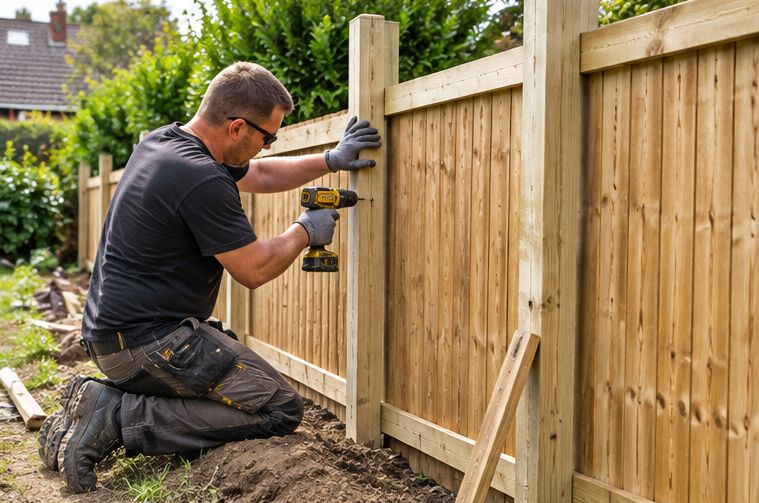
In a valley bottom the sun is already in short supply, and a tall solid fence on the wrong side can take away what little a garden gets. Before choosing a height, think about which side the light comes from. A slatted top section, a trellis topper or a slightly lower fence on the sunny side can keep a garden brighter while still screening the neighbours.
Paler fence stains also help a dark yard feel bigger than deep brown or black. Our guide to garden ideas for Aberbeeg valley-bottom homes has more ways to bring light into a shaded plot.
Helping timber last in a damp valley
Timber that stays wet will not last as long as timber that dries out between showers. A few simple choices help a lot:
- Gravel boards so no panel or board sits on the soil.
- Keeping soil, compost and leaf piles away from the base of the fence.
- Cutting back ivy and shrubs so air can move along the boards.
- Treating or staining the timber every few years.
- Using galvanised or stainless fixings that will not rust and stain.
There is more on this in our guide on how to make a garden fence last longer.
Gates, steps and narrow side paths
Many homes in Aberbeeg have a narrow path round the side, or steps up from the road to the garden. Gates in those spots need to open the right way, clear the step and close without catching on sloping ground. A gate hung on a slope may need to open away from the rise, or be set slightly higher with a threshold to clear it.
We fit timber gates to match the new fence and can hang them on sturdy posts that will not drop. Our guide on choosing and fitting a garden gate covers styles and hardware.
Heights, neighbours and next steps
As a general guide, fences over a certain height, or next to a road or footpath, may need planning permission, so check with Blaenau Gwent council before building anything tall or at the front of the house. Where a fence is on a shared boundary, it is always worth agreeing the line and style with your neighbour first.
The cost of a new fence depends on the length, the height, the slope, the ground, the style and whether an old fence has to come down and be taken away. Tony and the team will look at your boundary and give you a free, clear quote. Get in touch to arrange a visit.
Talk to T J Landscapes about your garden
Free quotes and honest advice across South Wales.
Questions People Ask
Should my fence be stepped or follow the slope?
Stepped panels suit gentle or stepped ground and standard panel fencing. On steeper slopes a raked close board fence usually looks tidier and leaves no gaps underneath. We can show you both on site.
Why do fences in Aberbeeg lean so often?
Soft, wet ground and posts that are not set deep enough are the usual reasons, sometimes made worse by a bank moving behind them. Deeper holes, good concrete and gravel boards make a big difference.
Will a tall fence make my garden darker?
It can, especially in a valley where the sun is low for much of the year. Consider a slatted design, a trellis topper or a lower height on the sunny side to keep the light.
Can you replace just part of a fence?
Yes. If the posts are sound we can replace boards or panels, and if a few posts have gone we can reset those. Where the whole run is failing, replacement is usually better value. See fence repair or replacement.
Do you take the old fence away?
Yes, old panels, posts and concrete can be removed as part of the job. If the boundary is overgrown, we can clear it first. See clearing overgrowth from an Aberbeeg garden.