
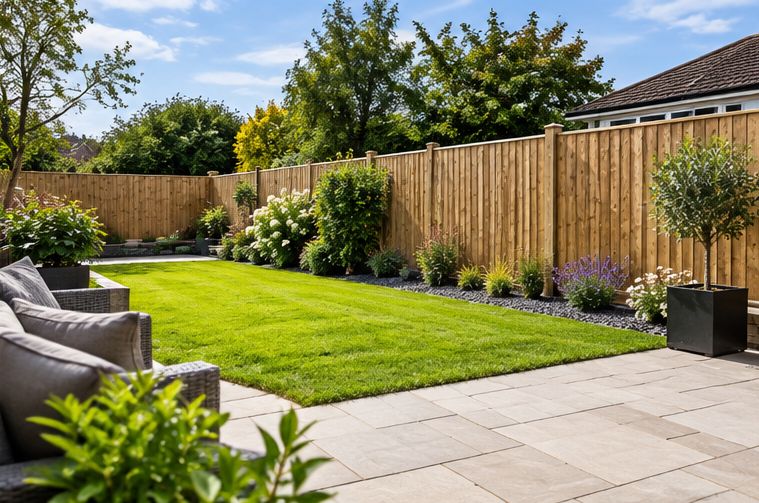
Around Monmouth you find two very different kinds of boundary. In town, gardens sit close together and people want privacy, security and somewhere for the dog to roam safely. On the rural edge, plots are larger, fields and woods lie beyond, and the aim is often to mark the line without shutting out the countryside.
Those two needs point to two classic fences: open post and rail, and solid close board. This guide explains where each one earns its place on a Monmouth property and the practical points we check before building either. For the full range of fence styles, see our guide to close board, panel or slatted fencing.
What each fence actually is
Post and rail is the open fence you see around paddocks and country gardens: stout posts with two, three or four horizontal rails between them. It can be left open, or backed with stock netting or rabbit wire to keep animals in or out.
Close board, sometimes called featherboard, is a solid fence built in place. Posts carry horizontal arris or back rails, and vertical boards are nailed on so each one overlaps the next. A gravel board along the bottom keeps the boards off the soil. It is stronger than most ready-made panels and can be built to follow a slope.
Where post and rail makes sense
Post and rail suits the bigger plots outside Monmouth, where the view across fields or woods is part of what you bought. It defines the boundary clearly while keeping the garden open, and it lets wind pass through rather than pushing against it, which helps on exposed ground.
- Long boundaries where a solid fence would be heavy-looking and expensive.
- Paddocks and grazing, usually with stock netting added on the animal side.
- Dividing a garden into areas without blocking light, such as fencing off a vegetable plot or orchard.
- Alongside a new hedge, protecting it while it grows, so the hedge eventually becomes the real boundary.
It does not give privacy, and on its own it will not stop a determined dog. Where either matters, it needs netting, a hedge or a different fence.
Where close board earns its keep
In the centre of Monmouth and on the newer estates around the town, close board is usually the better choice. It gives full privacy at the usual garden height, screens a patio from neighbours and keeps children and pets in. Because the boards are fixed individually, it copes better with an uneven or sloping line than a panel fence, and damaged boards can be replaced one at a time.
It is also more resistant to wind than most lightweight panels, provided the posts are sound. Our guide on which fence stands up best to Welsh wind explains why.
Mixing both on one property
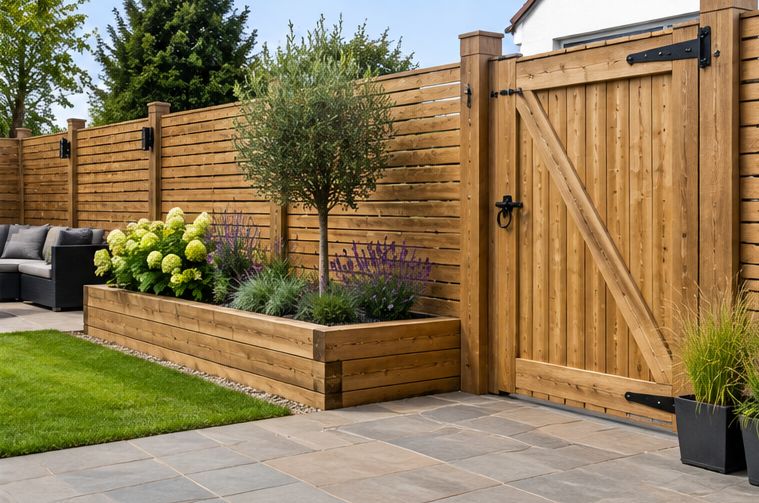
Plenty of homes on the edge of Monmouth need both. A common arrangement is close board around the private part of the garden near the house, where you sit and eat, with post and rail around the outer lawn, orchard or paddock. The change between them can be marked by a gate or a short section of wall.
This keeps privacy where it matters without enclosing an entire plot in solid fencing. It is part of how we plan large rural garden makeovers around Monmouth, where boundaries are usually one of the first stages.
Setting posts in soft or wet ground
Whatever the fence, it is only as good as its posts. On the low, damp land near the Wye and the Monnow, timber posts sit in wet soil for much of the year, and that is where rot starts. Concrete posts, or timber posts set with care, fill the gap.
For close board, we often use concrete posts and gravel boards, which do not rot and give a long life in damp ground. For post and rail, timber posts are traditional and look right in the countryside; we use pressure-treated posts rated for ground contact and set them deep enough to stay firm. The trade-offs are covered in concrete posts or timber posts.
Upkeep over the years
Post and rail needs very little attention. Every so often a rail may split or come loose where livestock lean on it, and it is a quick repair. Left untreated, pressure-treated timber weathers to a soft silver-grey that suits a country setting.
Close board has more surface to look after. A coat of water-based fence treatment every few years keeps the boards from drying out and splitting, and keeping climbers, ivy and soil off the boards helps them last. Shrubs planted right against the fence hold moisture in, so leave a gap. Our guide on making a garden fence last longer has more practical tips.
Gates for each kind of fence
A post and rail boundary usually wants a matching field-style gate for vehicles and a smaller bridle or pedestrian gate beside it. A close board fence is normally paired with a solid, ledged and braced gate that locks. Either way, the gate posts take far more strain than the fence posts and need to be heavier and set deeper. Our guide to choosing and fitting a garden gate goes into more detail.
Neighbours, heights and hedgerows
Before replacing a boundary, check who owns it. Deeds sometimes show this, and it is always worth speaking to the neighbour first. As a general guide, fences up to two metres high in back gardens, or one metre next to a road, do not usually need planning permission, but the rules are different for listed buildings and conservation areas, and parts of Monmouth fall into both. Check with Monmouthshire County Council if in doubt.
In the countryside, removing an established hedgerow can need the council's agreement, so talk to them before taking one out to make way for a fence. We are landscapers rather than planners, and we will always suggest you check first.
Talk to T J Landscapes about your garden
Free quotes and honest advice across South Wales.
Questions People Ask
Which fence is cheaper to put up, post and rail or close board?
Post and rail generally uses less timber, but the overall cost depends on the length of the run, ground conditions, access, the post type and whether netting or gates are needed. We price your boundary in a free quote.
Will post and rail keep my dog in?
Not on its own. Adding stock netting or a welded mesh on the inside usually does, provided it runs down to ground level and the gates close properly.
How high can I build a close board fence?
Up to two metres in a back garden is usual without planning permission, and one metre beside a road. Listed buildings and conservation areas can have extra rules, so check with the council.
Do you fence large plots around Monmouth?
Yes. Long rural boundaries, paddocks and garden divisions are all part of our fencing and gates work. More about our local work is on the Monmouth landscaping page.
How do I arrange a visit?
Send us the rough length of fence and a few photos through the contact form, and we will visit, walk the boundary and give you a free quote.