
Tree Surgery in Chepstow
Tree pruning
Pruning on a Chepstow slope means taking out dead and hanging branches that would otherwise fall straight down the hill onto steps, glasshouses or the garden below.
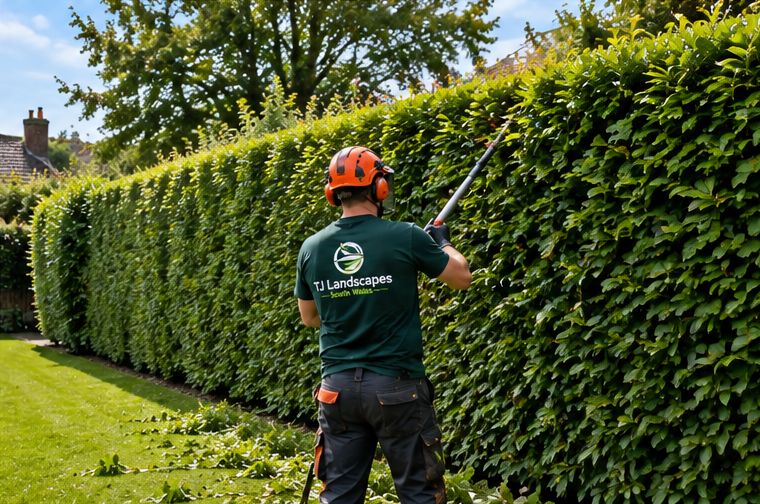
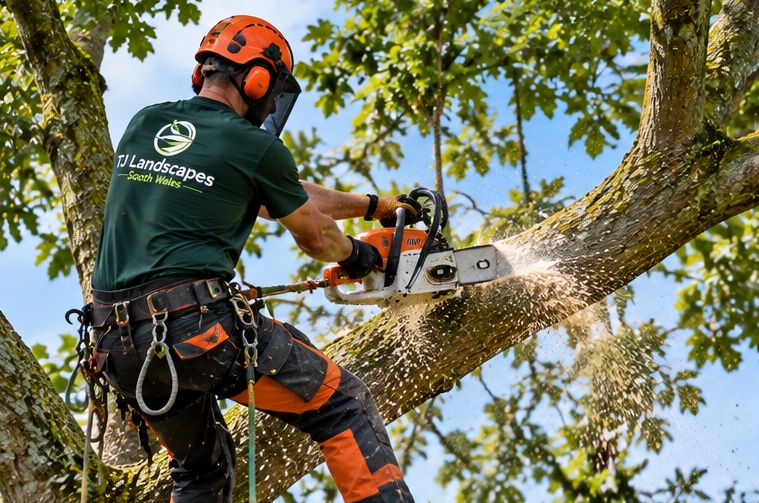

Trees in Chepstow rarely stand on flat ground. They grow out of banks, lean over stepped gardens and root into the old stone walls that hold up half the town’s back gardens. That makes the tree itself only part of the question. The slope below it, the wall beside it and the neighbour further down the hill all matter as much.
T J Landscapes prunes, reduces and fells trees and cuts back hedges across Chepstow, and we plan every job around the ground it sits on. Tony and the team give free quotes and straight advice. The full service is on our tree surgery and hedge care page, our wider work in the town is on the Chepstow landscaping page, and you can send us a few photos to get started.
What each type of work looks like when the garden climbs away from the house and the boundary is a stone wall.
Pruning on a Chepstow slope means taking out dead and hanging branches that would otherwise fall straight down the hill onto steps, glasshouses or the garden below.
Crown lifting clears the path and steps beneath a tree, while a careful reduction takes weight off a tree leaning out over a steep drop or a neighbour’s wall.
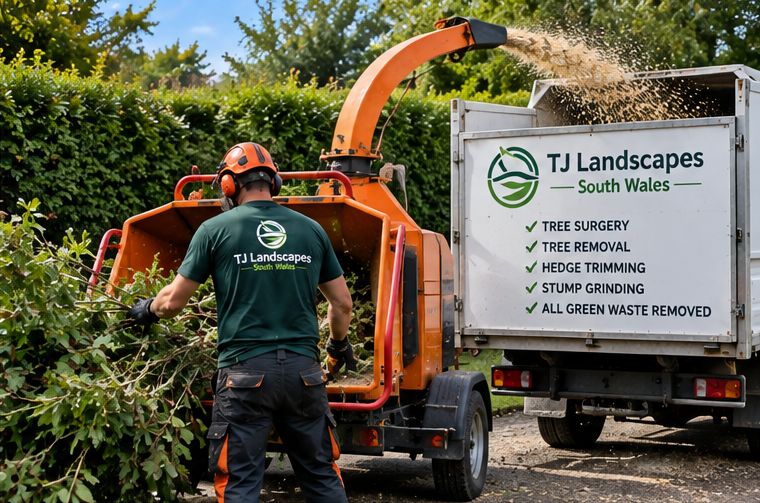
Felling is nearly always done in sections here, with each piece lowered on a rope and stacked on a level terrace, because anything dropped on a slope tends to keep rolling.
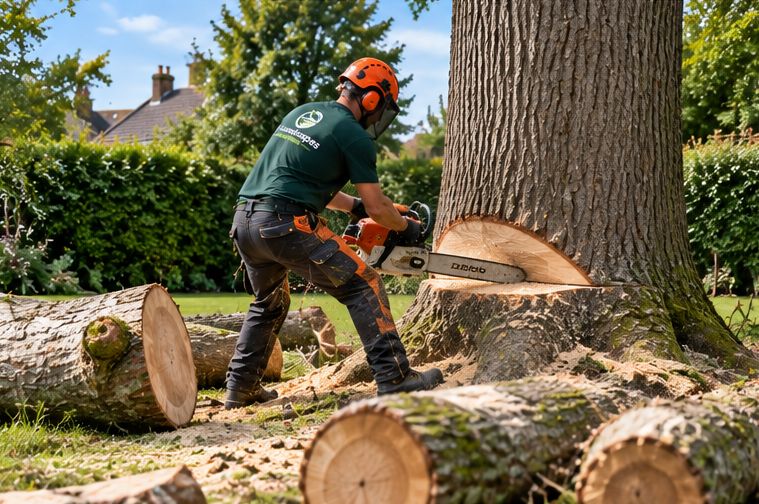
Topping is kept for conifers used as screens along Chepstow boundaries, where holding a steady height stops them blocking the view across the valley.
Hedges on banks and terraces need cutting from secure footing, so we work from the level ground above and below rather than balancing a ladder on a slope.
Stumps next to old stone walls are ground carefully or cut low and left, because tearing out the roots can pull the wall apart with them.
Walk down almost any Chepstow garden and you will find a sycamore, ash or elder that started life as a seedling in the joints of a stone wall. Left alone, the trunk thickens and the roots push the stones apart. Taking the tree out is often right, but pulling the roots can bring the wall down, so the usual approach is to cut the tree low, treat what is left so it does not regrow, and repair the stonework afterwards.
Where a bigger tree stands a little way back from a boundary wall, a crown reduction can take the weight and wind load off it without disturbing the roots. Our guide to tree surgery near boundaries in Chepstow covers this in more depth, and if the wall needs attention too, see repairing old stone garden walls and our brickwork in Chepstow page.
On a steep plot, the route out matters more than the cutting. Branches may need to travel up a long flight of steps to the road or down a narrow side path, so we cut to a size that can be carried safely and clear as we go. Rounds of trunk are rolled onto flat spots and split rather than left to slide into the neighbour’s garden.
We also look at what sits downhill before we start: a greenhouse, a shed roof, a car parked in the lane. Everything is lowered under control, never thrown. For a feel of how the day runs, see what happens on the day a tree surgeon visits.
We do the slopes, the walls and the trees, so nothing gets left half-finished. Our reviews on Google, Checkatrade and this site back that up.
We plan each job from the slope up: where the wood lands, where it goes next, and how the garden is protected.
Roots in stonework are handled so the tree comes out and the Chepstow wall stays standing, with repairs if needed.
Prune, reduce or fell: we explain the choice in plain words, with our guide to felling or pruning to back it up.
After the tree work we can build steps, terraces or fencing in Chepstow along the new, lighter boundary.
The historic centre of Chepstow includes a conservation area, and some trees around the town carry preservation orders. In a conservation area you generally have to tell Monmouthshire County Council before most tree work, and protected trees need its consent. We will remind you at the quote stage, and do you need permission to cut down a tree in Wales? sets out the general rules.
Ash dieback has also reached many trees in the Wye valley and across Wales. An affected ash near a path, road or house can become brittle, so if you have an ash with thinning, dying branches in your Chepstow garden, it is worth having it looked at.
Neighbours matter more on a hillside, too. A tree at the top of your plot may overhang two or three gardens below it, and its leaves end up in their gutters. You can generally cut overhanging branches back to your own boundary if the tree is not protected, but a quick chat with the household downhill before we start saves a lot of awkward moments.
Real reviews from homeowners across Chepstow — rated 4.8 out of 5 on Google from 69 reviews and 10/10 on Checkatrade.
“Had my patio done by the company and could not be happier. Top quality work done and quickly too.”
“I was pleased to find Tony and his lads were absolutely great! Tony responded quickly & was very polite.”
“We were delighted with the work and materials, which were of very high quality. Tony and team helped us.”
Local and practical guides to help you plan the work.
One team for the whole garden, so a single visit can price everything you have in mind.
We cover Chepstow and the towns around it. Choose another area below.
T J Landscapes South Wales
24 Conway Road, Pontypool
Torfaen, NP4 6HL
We cover homes right across South Wales, from Cardiff and the coast up to the valleys and the Brecon Beacons.
Please do not pull it. The roots are often woven through the stonework, and pulling can bring the wall down. Cutting the tree low and repairing the wall is usually safer, and we can do both.
Yes. A great many Chepstow gardens slope, some very steeply. We plan the cutting and the carrying around the gradient, and if something is beyond what we can do safely we will say so.
For many trees, autumn and winter, when the leaves are off and the shape is clear. Some species prefer summer pruning, and hedge work avoids the nesting season where possible. When should trees be pruned? and hedge trimming: how often and when go into more detail.
It shortens the longest branches back to healthy side shoots, making the whole tree smaller and lighter while keeping its natural shape. Crown lifting, thinning and reduction explained compares it with the other options.
The size of the tree, the steepness of the garden, how far the wood has to be carried, what is near it (walls, roofs, wires), the amount of waste and whether the stump is dealt with. Get a free quote for a real answer.
Tell us about the tree, the slope and the way into the garden. Photos from above and below the tree are a great help.