
Tree Surgery in Abergavenny
Tree pruning
Formative and maintenance pruning keeps a young tree growing in the right direction, so it frames a view of the hills from the house rather than filling it in ten years’ time.

In Abergavenny, a tree is judged by what it hides. Plenty of people bought their house for the view of the Sugar Loaf, the Blorenge or the Skirrid, and then watched a neighbour’s conifer or their own birch slowly climb into it. At the same time, the hedges and trees on the windward side are what make a hillside garden bearable when the weather comes down the Usk valley.
T J Landscapes helps Abergavenny gardens strike that balance. Tony and the team thin, lift and reduce trees to open up a view, fell what has to go, and trim, restore and lay hedges for shelter. Quotes and advice are free. See the full tree surgery and hedge care service, our Abergavenny landscaping page, or tell us what you want to see from the garden.
How each of the six kinds of work we do tends to be used in and around Abergavenny.
Formative and maintenance pruning keeps a young tree growing in the right direction, so it frames a view of the hills from the house rather than filling it in ten years’ time.
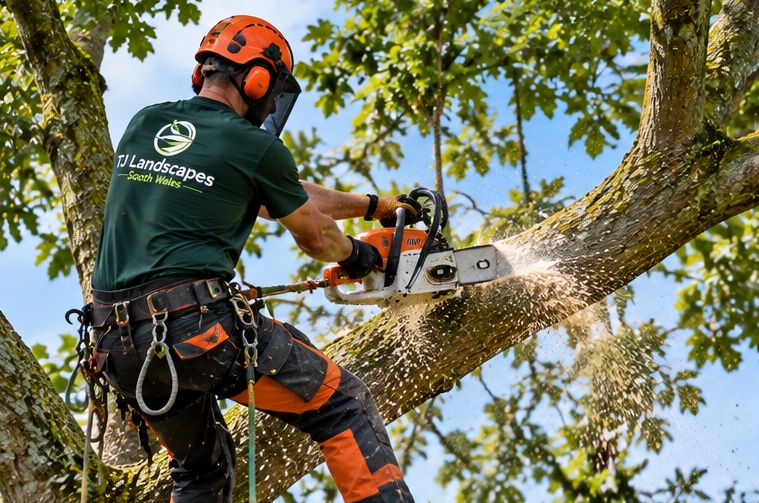
Crown thinning and lifting are the gentlest ways to see through or under a tree to the Blorenge or the Skirrid, while a careful reduction lowers one that has simply grown too tall.
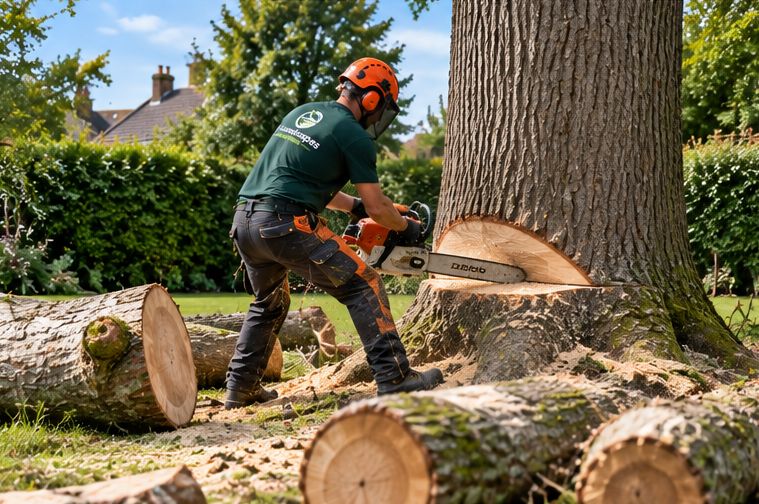
Felling is sometimes the honest answer when a fast tree was planted in the wrong place on an Abergavenny hillside, and we replace the shelter it gave where needed.
Topping conifer screens every year or two holds them below the sightline, which is often the neighbourly compromise between privacy and a mountain view.
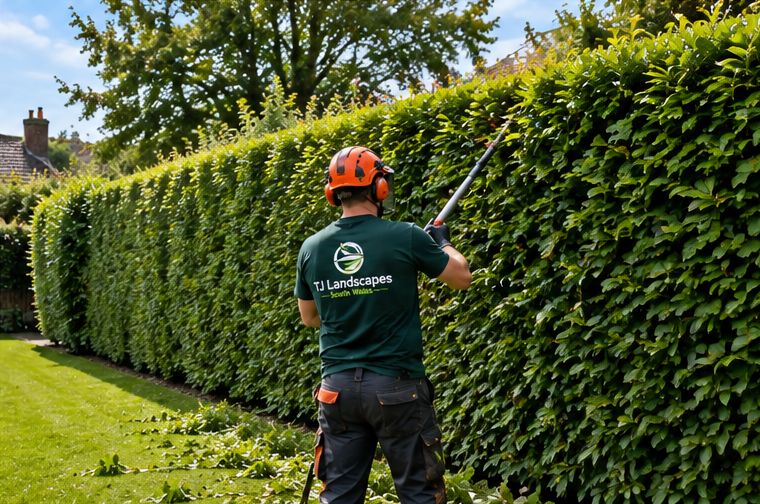
Hedges are the main windbreak for many Abergavenny plots, so we trim to keep them thick at the base, and can lay an old field hedge in the traditional way to renew it.
Grinding out stumps leaves room for new planting, a low wall or a seating area placed to look straight out at the hills.
Most view problems do not need a felling. Lifting the lower crown lets you see beneath a tree from a raised terrace; thinning the canopy turns a solid screen of leaves into a dappled one; reducing the top brings the whole tree back below the skyline. Often a combination of two gives the view back while keeping the shade, the birds and the sense of enclosure a garden needs.
We will stand where you sit and look out with you before suggesting anything. Crown lifting, thinning and reduction explained describes each technique, and our guide to landscaping an Abergavenny garden with mountain views looks at the rest of the layout.
On the exposed plots above the town, a good hedge filters the wind rather than blocking it, which is why it often shelters a garden better than a solid fence. Beech, hawthorn and mixed native hedges suit the area well. Trimmed once or twice a year, they stay dense right down to the ground. Our guide to hedge trimming: how often and when has the detail.
Trees on the windward edge need thinking about in the same way. Take out a big tree that has sheltered a garden for decades and the plants behind it may suddenly face the full force of the weather. Where a tree has to come down on an exposed Abergavenny plot, we usually suggest planting a new hedge or small trees in the gap at the same time.
Old field hedges on the edge of Abergavenny that have grown tall and gappy can be laid: the stems are partly cut, bent over and woven along the line so the hedge regrows thick from the base. It is a winter job, done outside the nesting season. Read more in hedge laying and hedge care around Abergavenny. Where a hedge cannot do the job alone, see fencing in Abergavenny.
We are a short drive away in Pontypool, and our reviews on Google, Checkatrade and this site describe how we work.
We think about the wind as well as the view, so opening a sightline does not leave the garden bare and exposed.
Traditional hedge laying is one of the older skills we still use, and it suits the field hedges around Abergavenny.
Thin, lift, reduce or fell: we explain each option, and felling or pruning sets out how we decide.
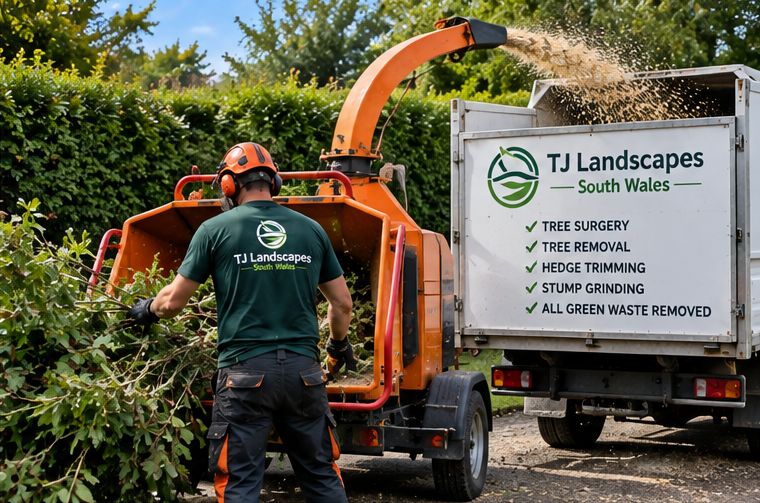
Brash is chipped and taken away, logs stacked if you want them, and lawns and paths left swept, as described in what happens on the day.
The centre of Abergavenny includes a conservation area, and some trees in and around the town have preservation orders. For most homes, Monmouthshire County Council is the one to ask. Some properties on the surrounding hills fall inside the Bannau Brycheiniog National Park, where the National Park Authority handles tree matters instead. Do you need permission to cut down a tree in Wales? gives the general picture.
Birds matter here as much as anywhere. Hedges and dense trees are checked before any cutting in spring and summer, and larger jobs are usually planned for autumn and winter, which also suits the pruning calendar in when should trees be pruned?
Real reviews from homeowners across Abergavenny — rated 4.8 out of 5 on Google from 69 reviews and 10/10 on Checkatrade.
“Had my patio done by the company and could not be happier. Top quality work done and quickly too.”
“I was pleased to find Tony and his lads were absolutely great! Tony responded quickly & was very polite.”
“We were delighted with the work and materials, which were of very high quality. Tony and team helped us.”
Local and practical guides to help you plan the work.
One team for the whole garden, so a single visit can price everything you have in mind.
We cover Abergavenny and the towns around it. Choose another area below.
T J Landscapes South Wales
24 Conway Road, Pontypool
Torfaen, NP4 6HL
We cover homes right across South Wales, from Cardiff and the coast up to the valleys and the Brecon Beacons.
Often, yes. Lifting the crown, thinning it or reducing the height can each bring a view back. Which works best depends on where you look from and the species. We will show you what we suggest before cutting anything.
Start with a friendly conversation, as many neighbours are happy to have a screen topped. You may cut overhanging branches back to your boundary if the tree is not protected, but not the height. For a genuine dispute over a tall hedge, Monmouthshire County Council can explain the high hedges process.
Hedge laying is done in winter, from around late autumn to early spring, when the hedge is dormant and before birds start nesting. It suits overgrown native hedges of hawthorn, hazel and similar species.
The town centre is outside it, but some homes on the hills around Abergavenny are within the Bannau Brycheiniog boundary. Check the National Park Authority’s map or ask the council, since it changes who you contact about protected trees.
The size of the tree or length of hedge, the slope and access, how exposed the site is, how much waste leaves and whether stumps come out. A free quote after a visit gives you a clear figure.
Tell us about the tree or hedge, the view or shelter you are after, and how we reach the garden. A photo from your favourite seat helps.