
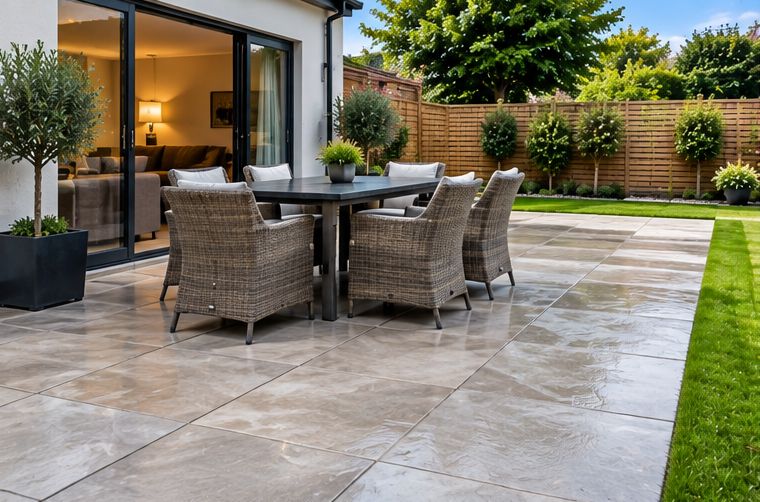
A patio is usually the biggest single surface in a town garden, so it sets the tone for everything else. Behind a period house in the centre of Monmouth, the wrong colour or finish stands out immediately, while the right one makes a small garden feel settled and generous.
This guide is about choosing, not laying. We cover the general comparison in porcelain, sandstone or concrete and the construction in how a patio should be laid. Here we focus on what tends to work behind Monmouth's older homes and the practical points that come with them.
Take your colours from the walls
Stand at the far end of the garden and look back at the house. The stone, brick and render you see there are your starting point. Warm, reddish or brown walls, which are common among older Monmouth buildings, sit well with buff, brown and mixed sandstones. Grey or rendered walls suit cooler blue-grey limestone or silver-grey stone and porcelain.
Bring a sample or two outside and look at them wet as well as dry. Most stone darkens noticeably in the rain, and in a town garden that is shaded for part of the day it may spend a good deal of the year looking like its wet self.
Natural stone for older houses
For most period town houses, natural stone is the first thing we suggest. It weathers in gently, looks at home next to old walls and has the slight variation in tone that makes a surface feel established.
- Indian sandstone comes in a wide range of warm and cool mixes, in riven (textured) or sawn (smooth-edged) finishes.
- Limestone gives a calmer, more even look, often in blue-black or grey tones, and suits Georgian formality.
- Natural stone in other types, including reclaimed flags, can match an older garden especially closely.
- Granite is very hard wearing and good for setts and edging, even if a whole granite terrace is less usual in a period garden.
Riven stone has a more rustic, cottage feel. Sawn stone with a tumbled or honed face looks crisper and suits smarter town houses. Either can be right; it depends on the house.
Where porcelain earns a place
Porcelain paving resists staining, is easy to keep clean and does not grow algae as readily as some sandstones. In a shady, damp courtyard behind a Monmouth terrace, those are real advantages.
The trick in a period setting is choosing a porcelain that behaves like stone: a natural texture, subtle colour variation and a mid-tone rather than bright white or charcoal. Laid with narrow joints close to the house and softened with planting, it can work very well even beside old brick.
Size, shape and pattern in a small plot
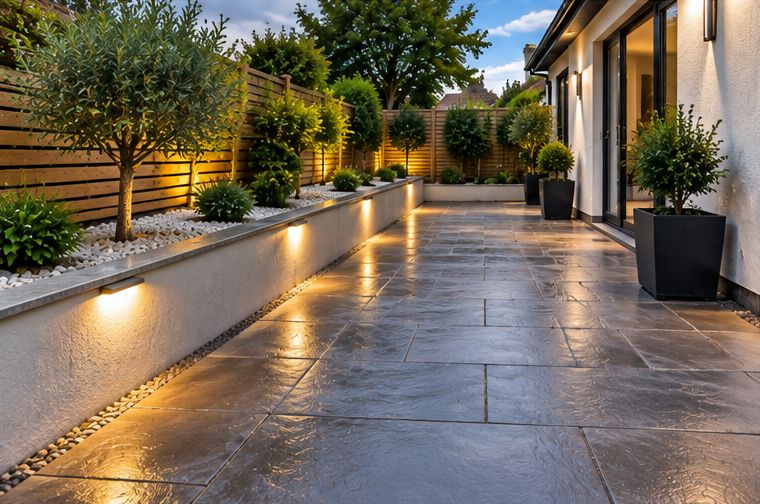
Big slabs in a small garden are often assumed to look cramped, but the opposite is usually true. Fewer joints make a space feel calmer and larger. A mix of sizes laid in a random or coursed pattern is the traditional choice for sandstone and suits older homes.
In a long, narrow plot, running the slabs across the width rather than down the length can make the garden feel wider. A border of brick or setts around the edge frames the patio and ties it back to the walls, and is a good way to use a few reclaimed bricks.
Think about the path too. Carrying the same stone through the garden in a narrower band keeps things joined up. Our article on garden design ideas for Monmouth period properties has more on laying out long plots.
Joints and edges make more difference than you expect
The colour of the pointing changes the whole look of a patio. A joint that matches the stone disappears and gives a soft, traditional finish, while a strongly contrasting one draws attention to every slab. For period houses we usually suggest a mid-tone that sits between the paving and the walls.
Modern brush-in jointing compounds are neat and quick, and they suit porcelain and sawn stone well. A traditional mortar joint, slightly recessed, can look more at home with riven sandstone. Whichever you choose, the edges matter as much as the joints: a clean soldier course of brick, or setts bedded in mortar, stops the patio looking unfinished where it meets the lawn or borders.
Levels, old walls and damp
Older houses need extra care at the back wall. The finished patio should sit well below any damp-proof course, usually by at least two brick courses, and fall gently away from the building so rain runs off rather than towards it. Where a period house has no obvious damp course, we keep the paving low and leave a gap or a gravel strip against the wall so the masonry can dry out.
Air bricks and old vents must stay clear. Raising a patio over them is a common cause of damp problems. If the garden slopes up from the house, a few steps down to the patio or a small retaining wall may be needed to get the levels right.
Getting the stone into the garden
Many Monmouth town houses have no side access at all, so every slab, bag of sand and barrow of spoil goes through a hallway or a narrow passage. It is perfectly workable, but it shapes the job. We protect floors and doorways, choose slab sizes that can be carried safely and plan the order of work so the house is not blocked for longer than needed.
Parking and deliveries can also be tight in the older streets, so we arrange drop-offs carefully and keep the pavement clear. None of this changes what paving you can have; it just adds time, and we build that into the quote.
Front gardens, conservation areas and drives
Paving a front garden is a bigger decision than a back patio. Where the house is listed or in a conservation area, changes to front walls, railings and surfaces may need consent, and there are also rules on hard surfaces that do not drain. Check with Monmouthshire County Council before starting. Our patio and paving page covers paths and driveways, including permeable options.
Talk to T J Landscapes about your garden
Free quotes and honest advice across South Wales.
Questions People Ask
What paving looks best behind a period house in Monmouth?
Natural stone is the usual choice, especially sandstone or limestone in colours that pick up the house walls. A textured, stone-coloured porcelain can also work if you want easier upkeep.
Is porcelain too modern for an older home?
Not necessarily. Choose a natural texture and a muted tone, keep the joints neat and soften the edges with planting. It suits shady, damp courtyards particularly well.
We have no side access. Can you still lay a patio?
Yes. We carry materials through the house with floors and doorways protected, and choose slab sizes that can be handled safely. It adds time rather than ruling anything out.
Can you match the stone to our old walls?
We bring samples on our visit so you can compare them against the house in daylight, and we can include reclaimed stone or brick edging where it helps.
How do I get a quote for a Monmouth patio?
Use the contact form to send a note and a few photos. We visit, measure up and give you a free quote. See our Monmouth landscaping page for more on our local work.