
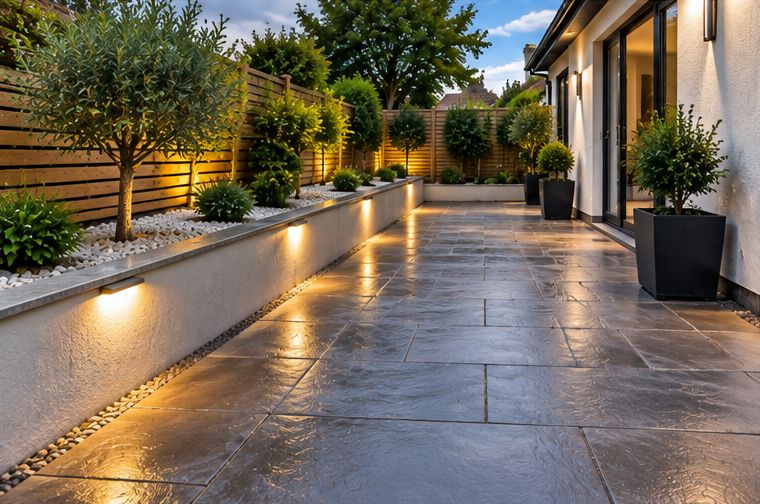
The older cottages and terraces of Aberbeeg were built long before anyone thought about outdoor dining. Their back yards and gardens tend to be compact, bounded by stone or brick, and often set against steep ground. A well-chosen patio can turn one of these spaces into the most used room of the house for half the year.
This guide covers what we think about when paving a cottage garden in the village: the stone, the levels, the layout and the practical business of getting slabs to the back. It is the local side of our patio and paving service. For our wider work here, see landscaping in Aberbeeg.
What an older cottage asks of a patio
A new-build patio can be almost any colour or style. A cottage patio looks best when it feels as if it belongs to the house. That usually means natural textures, modest sizes and colours that sit comfortably with old stone, render or brick.
Older buildings also bring practical demands. Walls may have no modern damp-proof course, or one that sits lower than you would expect. Yards may already have old flags, concrete or a mix of both. Drains, manholes and downpipes are rarely where a modern plan would put them. All of that has to be worked around, not paved over.
Boundary walls are another consideration. Many cottage yards in Aberbeeg are enclosed by old stone or brick, and digging close to their base can undermine them. We keep an eye on how deep we go near any old wall and point out anything that looks unstable before work starts.
Choosing stone for a shaded, damp yard
Many Aberbeeg gardens spend much of the winter in shade, so the paving will stay damp for longer than it would on an open hillside. That points towards materials with a bit of grip and colours that brighten the space. The main options we lay are:
- Indian sandstone: warm buff and grey tones with a naturally riven surface that looks at home beside an old cottage.
- Natural stone: a traditional look with plenty of texture, well suited to period properties.
- Porcelain: very low porosity and easy to clean, which helps where algae is a problem. Pick an outdoor-rated slab with a textured finish.
- Limestone: softer, lighter tones that can lift a dark yard, though some finishes mark more easily.
Our general guide to which patio paving copes best with Welsh rain compares the materials side by side. In a cottage yard, we would usually steer you towards lighter shades and a riven or textured surface.
Levels and falls beside old walls
This is where cottage patios most often go wrong. The finished paving should sit at least two brick courses below the damp-proof course, or below the internal floor level where there is no obvious course. Raising the ground against an old wall can bridge moisture into the house.
The patio also needs a gentle fall so rain runs away from the building, not towards it. In a narrow yard with walls on three sides, that water needs a clear exit, which may mean a channel drain at the low edge or a gravel margin that lets it soak away. Old gullies are checked and kept accessible.
Getting these details right underneath is covered in our guide on how a patio should be laid. On damp ground, a well-compacted sub-base matters even more, because soft soil is what makes slabs sink and rock later.
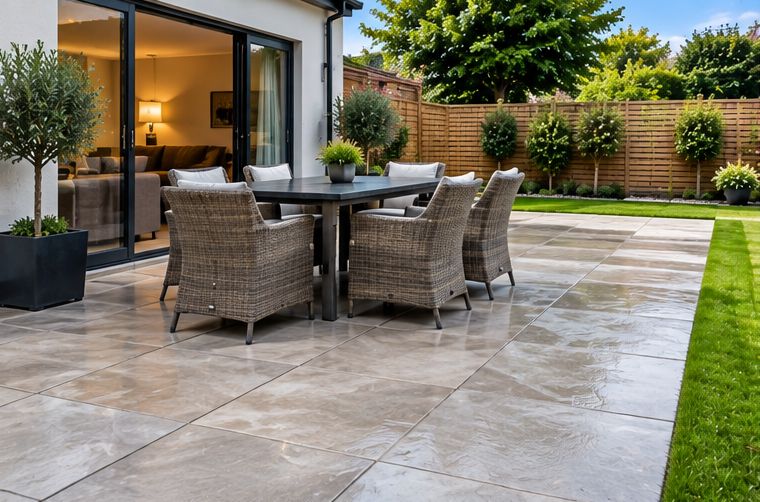
Layouts for small cottage gardens
In a compact Aberbeeg garden, the patio often is the garden, or most of it. A few ideas that tend to work well:
- Pave the whole yard, but leave planting pockets and a border along the sunniest wall.
- Use larger slabs in a simple pattern, which can make a small space feel calmer and bigger.
- Put the seating where the evening light reaches, even if that is the far end of the yard.
- Combine a small patio with a step up to a raised bed or a terrace on the slope behind.
If the garden climbs behind the house, a second small paved area higher up may catch more sun than the yard itself. Our guide to garden ideas for Aberbeeg valley-bottom homes has more on working with the light.
Getting slabs to the back of the house
Access is one of the biggest practical questions on any job in the village. Some cottages have a front door straight onto the pavement and no side path, so everything goes through the house or up a lane. Others have steps between the road and the garden.
We look at the route before quoting. It affects how materials are delivered, how waste is removed and how long the job takes. Protecting floors and doorways, bringing in smaller loads and choosing slab sizes that can be carried safely are all part of the plan. Access sits alongside size, ground conditions, material choice and drainage as the things that shape the price.
Tight sites also need tidy working. Spoil from digging out the old surface has to leave the same way the new stone arrives, so we plan the order of work to avoid carrying things back and forth. On a small cottage job that planning often saves more time than any machine could.
Keeping a cottage patio looking good
Shaded paving will grow some green over time, whatever it is made of. A stiff brush and a gentle patio cleaner a couple of times a year usually keeps it in check. Avoid harsh pressure washing on natural stone and pointing, which can damage both.
Well-filled joints stop weeds and help the slabs stay put. Our guide on looking after a new patio covers the routine in more detail.
Talk to T J Landscapes about your garden
Free quotes and honest advice across South Wales.
Questions People Ask
Can you lay a new patio over the old concrete in my yard?
Sometimes, if the concrete is sound, well drained and the new levels will stay below the damp-proof course. Often the old surface is too high or cracked, and it is better to take it up. We check on the visit and explain which way we would go.
Which paving is least slippery in shade?
Textured or riven finishes give the most grip. Porcelain with an outdoor anti-slip rating and riven sandstone are both good choices. Any surface will need occasional cleaning in a shaded Aberbeeg garden to keep algae down.
How do you get slabs to a garden with no side access?
We plan the route before starting. That can mean carrying through the house with floors protected, using a rear lane, or bringing in smaller loads. It is one of the things that shapes each quote.
Will a patio make my damp garden worse?
Not if it is laid with the right falls and somewhere for the water to go. A badly laid patio can hold water, so drainage is part of the design. See dealing with damp ground in an Aberbeeg garden.
Can you add steps or a low wall with the patio?
Yes. Steps, raised beds and garden walls are often built at the same time, using our brickwork service. Ask for a free quote and we can price it all together.